Paul offered new bodies to his converts “in Christ”.

Like any new preacher in town, Paul sensed people were questioning him, doubting all the promises he made, like a resurrection of the dead (1 Cor. 15:12), like will it even happen at all or is Paul just a crank. Disbelieving converts were asking obvious questions like what do you mean- “How are the dead raised? With it what kind of body will they come?”(1 Cor. 15:35). It’s obvious people were skeptical of this new preacher, why wouldn’t they? Paul had promised them all new bodies! God would give these bodies to them. (1 Cor. 15:38).

Paul was trying to convince them of the visions he had of this recently executed prophet- (he had been the Anointed god had promised), he told them he wasn’t the only one who was having these visions (1 Cor. 15: 5-8). Paul’s rhetoric that if what he preached wasn’t true -that “Christ has not been raised, your faith is futile”- (1 Cor. 15:7) that was the rock Paul was willing to perish. And how did Paul know Jesus was raised? – Jesus had told Paul and others in a vision that god raised him!

With the Jewish concept of resurrection Paul promised the Corinthians all new bodies, these were spiritual bodies but not immaterial, they were made of the same finer material that spirits or angels were made of. “For Paul, flesh and blood do not inherit the kingdom of God.  They are done away with, because people are raised in spiritual bodies, just as Christ was.”[1] As “Flesh and blood cannot inherit the kingdom of God” (1 Cor 15:50), a new body was required.

These new bodies were for a kingdom of god, this entailed basic outlines of Jewish concepts with the added conviction that Jesus was coming back (1 Thess. 4:16-18).

Jesus being the “first fruits” (1 Cor. 15:20), has already got his new body. Perhaps Jesus had this type of body all along because Paul suggested this when he said “made of woman” as opposed to the more commonly way of expressing the common idiom “born of woman” (Gal. 4:4). Paul seems to break with the Biblical precedent of this idiom, using γίνομαι (ginomai = made) rather than γεννῶμαι (gennomai = born). With Paul using both expressions “made of woman”, “made under the law” could mean that Paul was emphasizing that Jesus was born with a divine body- which would make Paul a docetist! He still believed Jesus had walked the earth as he said had said we all knew of Jesus according to the flesh. (2 Cor. 5:16). Jesus with his new super body was coming back to start a new age, and all those “in Christ” can enjoy the mystery of getting these new bodies. (1 Cor.15:51-52; cf. Rom. 8:11). This new Christ cult was ready to compete with the mystery religions!

Paul offered all his new converts (those referred to as “in Christ”) all new bodies 1 Cor. 15:42, not just ordinary bodies but bodies made of the same stuff as heavenly beings (1 Cor. 15:40,44). The bodies of those “in Christ” would transform (1 Cor. 15:51,52). Not only that but those “in Christ” could also bring their dead loved ones along with the baptism of the dead. “material nature of the dead was assumed to transform, having received the divine “stuff ” of Christ.” [2]

Candida Moss had commented about ideas like these already existing in the Jewish world, “In his description of the various “philosophical sects” that made up ancient Judaism, the historian Josephus includes a summary of the views of the Essenes, the Pharisees, and the Sadducees on the question of the immortality (or not) of the soul after death. The Essenes, we are told, subscribe to a complicated view of the afterlife, akin to that of “the Greeks.” They believe that bodies are corruptible but that the soul is immortal. The Pharisees, he adds, subscribe to the idea of the incorruptibility of the soul and that the souls of the good will receive new bodies in the future. The Sadducees, by contrast, deny the existence of any kind of afterlife.[3]

The Essenes:

That bodies are corruptible, and that the matter they are made of is not permanent; but that the souls are immortal, and continue forever; and that they come out of the most subtile air, and are united to their bodies as to prisons, into which they are drawn by a certain natural enticement; but that when they are set free from the bonds of the flesh, they then, as released from a long bondage, rejoice and mount upward. (War 2.154-155)

The Pharisees:

They say that all souls are incorruptible, but that the souls of good men only are removed into other bodies,—but that the souls of bad men are subject to eternal punishment. (War 2.163)

Sadducces:

They also take away the belief of the immortal duration of the soul, and the punishments and rewards in Hades. (War 2.165)

Josephus also explains the Greek views of afterlife in War.

“souls are immortal; and thence are those exhortations to virtue, and dehortations from wickedness collected; whereby good men are bettered in the conduct of their life by the hope they have of reward after their death; and whereby the vehement inclinations of bad men to vice are restrained, by the fear and expectation they are in, that although they should lie concealed in this life, they should suffer immortal punishment after their death.” (War 2.155-156)


In his debate with Hansen, Richard Carrier has succcessfully shown that God has manufactured these new bodies “For we know that if the earthly tent we live in is destroyed, we have a building from God, an eternal house in heaven, not built by human hands.” [2 Cor. 5:1] These bodies are already in heaven; we have them waiting—not will have them, but already have them. They await us.”[4] While Paul deliberately swapped out born for made in a common idiom- born of woman, and later scribes in their fights with docitists changed the word back to born, this really has nothing to do with the futile mythicist/historicist – made/born debate that Carrier and Hansen carry out. This is my answer to that futile debate- it actually makes no difference if god manufactured new bodies for people that actually existed, I mean like Paul literally promised all new bodies for the newly converted, this argues against Mythicism. New bodies were made for actual people, Jesus being one of the first fruits was the first of an actual recently executed person who had one of those new bodies.

In one of my happy debates with a fellow facebooker, Christopher Frawley, we debated whether those “in Christ” received new bodies or kept their own body. I did not realize at the time we were both right. Frawley saying as Paul is a Pharisee (Phil. 3:5) he kept with the Pharisiac thought of getting a new body (War 2.163) and this was evidenced in 2 Cor. 5:1. Yet in 1 Cor. 15 Paul was on about the transformation of the body to the divine body (1 Cor. 15:51-54). It’s quiet clear in that passage that the body that will be raised will be ‘clothed’ with the new body, thereby transforming. The clue of the two of us being right is the same kinda thing happens in Baptism- Paul’s Baptism is not just an initiation/ purification rite but “institute a physical transformation of the gentile body.” The birth and death to Paul is consistent- “In Paul, we see a yoking of initiation rites with “magical” rites that involve wielding divine powers, such that the initiate is purported to transform into something new; what mortals call “death” is, in fact, the beginning of “real” life.”[5] In the passage in Romans quoted you’ll see this mystical union of bodies explained by Paul:

Or don’t you know that all of us who were baptized into Christ Jesus were baptized into his death? We were therefore buried with him through baptism into death in order that, just as Christ was raised from the dead through the glory of the Father, we too may live a new life. For if we have been united with him in a death like his, we will certainly also be united with him in a resurrection like his. (Rom. 6:3-5).

Paul not only promised new bodies but the means to get them- god will hand them out to those who die “in Christ” so that they won’t really die. This was what Paul was selling, a product much like the wildly popular mystery religions promising eternal life.


[1] Bart Ehrman, Did Paul Believe that the Fleshly Body Would be Resurrected – The Bart Ehrman Blog.

[2] Jennifer Eyl, Signs, Wonders, and Gifts, Divination in the Letters of Paul, Oxford 2019, p.142.

[3] Candida Moss, Divine Bodies, Resurrecting Perfection in the New Testament and Early Christianity, (Yale, 2019), p.15.

[4] Richard Carrier, “Chris Hansen on Jesus from Outer Space” retrieved from:

[5] Jennifer Eyl, Signs, Wonders, and Gifts, Divination in the Letters of Paul, Oxford 2019, p. 130.

Jesus’ Exaltation: Any which way we can!

Paul was a missionary who joined a thriving cult in existence, that had rituals (eg. Baptism 1 Cor. 12:13; Eucharist 1 Cor.11:23-24) , creeds (eg. 1 Cor. 15:3b-5; 1 Cor. 12:3, Rom. 1:3-4;10:9) and various missionaries – Paul was one of many missionaries that worked under James’ organisation (Gal. 2:12), others independent of Paul are occasionally mentioned in his letters, “Andronicus and Junia, apparently a missionary couple, were independent of him (Rom. 16:7); another couple, Prisca and Aquila, seem to have worked on their own, though sometimes in collaboration with Paul (Rom. 16:3, cf. Acts 18: 2); and doubtless there were many others.”[1] Many other missionaries were already out in the field ready to assist Paul, such as Euodia, Syntyche and Clement (Philippians 4:2-3). Paul was very jealous of Apollo (1 Cor. 1:12; 16:12).

Paul was very adaptable, As Paul said himself 

To the Jews I became like a Jew, to win the Jews. To those under the law I became like one under the law (though I myself am not under the law), so as to win those under the law. To those not having the law I became like one not having the law (though I am not free from God’s law but am under Christ’s law), so as to win those not having the law. 22 To the weak I became weak, to win the weak. I have become all things to all people so that by all possible means I might save some.

(1 Cor.9:20-22; cf. Rom. 6:14 for those not under the law).

By being not under the law was to facilitate the gentiles who did not want to circumcise, it made it easier for Paul to be a success by offering the Jewish God stripped of regulation.[2] Paul was a great persuader and whatever occasion confronted Paul determined how he dealt with it. “What he says, for example, about the role of the law seems to be highly contingent on the problem he is wrestling with. In different contingencies Paul gives different, contradictory answers.”[3]

The pre Pauline literature (ie stuff that Paul incorporated into his letters) we see reflected rather mixed ways of exalting Jesus. This is even within the authentic letters themselves much controversial and contradictory statements on how exactly Jesus came to be exalted so highly, as highly as the Jewish god in fact. Basically what we can see in the movement Paul joined and what Paul reiterated was using the Roman cultural preconceptions of Emperor apotheosis plus Paul was also reiterating the Hellenized Jewish practice of the once hidden now revealed schema that existed in second Temple literature. On top of these methods of exaltation, much of the language used to glorify the Jewish god got applied to Jesus as he was believed to be a messiah figure. This messiah title got very otherworldly, it became title for an end time figure through the apocalyptic presumptions of the time.

Jesus claiming to be either an eschatological prophet or believed to be a messiah and ending up on a cross had a devastating effect on Jesus’ followers. The execution without gods intervention would have caused a cognitive dissonance among his followers.[4]

Paul reiterated the cultural understanding of second temple understanding of resurrection, that created an expectation of Jesus’ return as some type of ends time figure. This is how the cognitive dissonance was beaten- Paul assured his followers that god did in fact intervene, how? – by resurrecting him! And how did Paul and the apostles know this?- because they were talking to Jesus through visions. That’s one way to beat cognitive dissonance! The gospels would later take on the Danielic/Enochian “son of man” as this end time figure. You can track a progression in the gospels themselves where Jesus was actually made into the “son of man.”

Paul also uses the title Lord Messiah, christos kurios for Jesus, let’s examine other contemporary documents that used this title such as the Psalms of Solomon (cf. Psalms of Solomon 17:21-32) “Christos most commonly stands for an End-time Davidic warrior and ruler. Traditions visible both in Paul’s letters and in the later gospels also present Jesus as such a redemptive End-time figure: returning with angels, coming on clouds of glory to gather his elect, bringing in the Kingdom with power.”[5]

In an examination of what we call various pre Pauline traditions incorporated into the letters we see various ways the earliest movement tried to exalt Jesus. Bart Ehrman does an extensive examination of preliterary traditions ie traditions that were formulated and transmitted orally before they were written down by the authors whose works we still have.[6]

It is from Paul’s letters that we see using the norms of recent imperial cults plus the more Jewish ways of how ancient hero’s were honored all being used in the exaltation of Jesus. Sometimes the very description for the Jewish god was used to exalt Jesus very soon after his death. 

For an example of two very different ways of Jesus’ exaltation I will quote EP Sanders here on two passages that got incorporated into the Pauline letters – Philippians 2:5–11 and Romans 1:1-3.

The two most substantial passages in which he commented on who Jesus was are Romans 1:1–6 and Philippians 2:5–11. In the first passage he states that Jesus was ‘descended from David according to the flesh and designated Son of God in power according to the Spirit of holiness by his resurrection from the dead’. The reader of this passage would understand that Jesus was ‘designated’ Son of God, and further that he was designated such only at the time of the resurrection. In later terminology, this is an ‘adoptionist’ Christology. Jesus was adopted by God as Son, not born that way.… [once hidden, now revealed schema caused the earliest followers to create the Philippians hymn- a piece of pre-Pauline literature that got incorporated into Paul’s letters. Philippians 2:5–11, Jesus was] … in the form of God’ before he was born, but then he took on ‘the form of a slave, being born in the likeness of men’. The passage continues, ‘and being found in human form he humbled himself and became obedient unto death’. God ‘highly exalted him and bestowed on him the name which is above every name’, that is, Lord. … Jesus was in the form of God, then he was in the form of a slave, that is, he was in human form…..the passage basically states that Jesus Christ was pre-existent and was in some sense divine, but that he became human before being exalted even higher than he had originally been, to the status ‘Lord’ [Paul] drew on, rather than composed, quite diverse statements, one offering a ‘low’ Christology, the other a ‘high’ Christology.”[7]

Another passage that presumes the ‘once hidden, now revealed’ schema is 1 Cor. 10:4 where Christ is the rock of Moses (Deut. 32:4), as if Christ had always existed but Paul is only revealing him now.

Here’s Margaret Baker take on the ’son of god’

Long before the first Gospel was written down, Paul could quote a Christian hymn, [Philippians 2:6-11] presumably one which his readers would recognize, and therefore one which was widely known … Similarly, at the beginning of Romans, Paul quotes what seems to be an early statement of Christian belief:

the gospel of God … concerning his Son, who was descended from David according to the flesh and designated Son of God in power according to the Spirit of holiness by his resurrection from the dead. (Rom. 1.3-4)

All the titles are there: Son of God, Lord and Messiah.”[8]

It was no wonder that Paul quoted a “son of God” creed in his letters to the Romans. This would have resonated well with the Roman audience familiarity with the imperial cult. Comparing Jesus divine sonship to the Emperors divine sonship exalts Jesus and shows his power. The most famous person in the world, the emperor, was divi filus.[9]

‘Son of God’ fragment 4Q246 from the DSS has some very interesting implications for the concept of the title ‘Son of God’ in Jewish messianism.

The text includes phrases such as “son of God” and “the Most High”, so the two references of Daniel 7:13-14: [10]

1.He will be called the son of God, they will call him the son of the Most High. But like the meteors 2. that you saw in your vision, so will be their kingdom. (“Son of god” text 4Q246 col 2)

This meteor reminds us of Octavian’s memoirs where we have “The common people believed that this star signified the soul of Caesar received among the spirits of the immortal gods, and on this account the emblem of star was added to the bust of Caesar that we shortly afterwards dedicated in the forum.”[11]

As this blog shows Jesus’ exaltation was drawn from the cultural environment of both hellenized Jews and Greco-Roman methods that were used to exalt figures from this time.


[1] E. P. Sanders, Paul, A New Very Short Introduction, (Oxford, 1991), p.7.

[2] Rabbi Shmuley Boteach, Kosher Jesus, (Gefen Publishing House, 2012), ch1.

[3] Jouette M. Bassler, “Paul and his Letters” ch. 21 in David E. Aune (ed)  The Blackwell Companion to the New Testament,  (Blackwell Publishing Ltd, 2010), p.173.

[4] Fernando Bermejo-Rubio, The Process of Jesus’ Deification and Cognitive Dissonance Theory, Numen 64 (2017) , pp.119-152.

[5] Paula Fredriksen, Paul, The Pagans Apostle, (Yale, 2017), p.135.

[6] Bart Ehrman, How Jesus Became God: The Exaltation of a Jewish Preacher from Galilee, (HarperOne, 2014), ch.6

[7] E P Sanders, Paul: A Very Short Introduction, ch8.

[8] Margaret Baker, The Great Angel, p.2

[9] Peppard, The son of God in the Roman World.

[10] Israel Knohl, The Messiah before Jesus.

[11] Pliny, Natural History, trans. H. Rackham (Cambridge: Harvard University Press, 1958). Cf Suetonius, “Iulius,” 88, in The Lives of the Caesars; Dio Cassius, Roman History 45.7.1; Servius on Virgil, Eclogues 9.46.

Many Movements very like “Proto-Christians” actually existed, making it no surprise that a movement like Christianity arose in the aftermath of Temple Destruction.

There was also another body of wicked men [other than the Sicarii] gotten together, not so impure in their actions, but more wicked in their intentions, which laid waste the happy state of the city no less than did these murderers. These were such men as deceived and deluded the people under pretense of Divine inspiration, but were for procuring innovations and changes of the government; and these prevailed with the multitude to act like madmen, and went before them into the wilderness, as pretending that God would there show them the signals of liberty. But Felix thought this procedure was to be the beginning of a revolt; so he sent some horsemen and footmen, both armed, who destroyed a great number of them. (Josephus, War 2.258-60)

When Solomon Zeitlin read the passage on the Sign Prophets under Felix it led him to note: “Apocalyptists who are the forerunners of the Christian movement.” [1] Yes Jesus being one in a series of Sign Prophets makes all these movements sound like a proto-Christian one as Zeitlin described. Josephus makes an important distinction between the Sign Prophets and the Sicarii in this passage he said the former were “not so impure in their actions” (War 2.258). This suggests the religious fervour of these groups. These Sign Prophets were distinctive in that they all “led their followers into (anticipated) participation in some great liberating action by God.”[2] As Hengel had noticed in the Rabbinic literature centuries later, we have disapproving rabbis of the Sign Prophets who were trying to “force the end.”[3] “The Jewish prophets believed that Israel had suffered enough and that the slavery under Roman rule would soon come to an end, at the time appointed by God. They must have linked the biblical tradition of Moses and its signs and wonders with that of Daniel, to whom the timetable of the eschatological events had been disclosed in a vision (Dan. 9:20-27). The prophets’ claims of being inspired by God (War 2.259) certainly included the conviction that they knew the mysteries of God, especially the future events and the time of their coming.” [4] “In the War passage Josephus uses words such as “change” and “innovation” suggesting political change from Roman rule, that that was the freedom promised and would be brought about by God. In the report about John the Baptist, for example, change has political overtones.” [5] “We are not searching for Jesus the individual in himself, but for Jesus-in-relationship, Jesus-in- interactive-role(s). A focally important aspect of a relational and contextual approach to Jesus is attempting to discern what interactive roles he was playing or in which he was being placed by his followers/movement(s). … [We can] detect a few roles that were very much alive in popular circles. Josephus’s accounts of the prophets Theudas and “the Egyptian” are evidence of prophets like Moses and/or Joshua who led movements of renewal of Israel at the popular level. The credibility of this role is enhanced by parallel evidence from the scribal level, in the “prophet like Moses” in Deuteronomy and the Moses-like portrayals of the Righteous Teacher in Qumran literature. … That Mark, Q speeches, Matthew and John all represent Jesus so prominently as resembling or imitating Moses and Elijah in both his actions and his speeches makes it all the more inviting to reason back toward Jesus’ adaptation of such roles.” [6] Not only did Jesus adapt a role, the crowd that followed him believed that god was going to intervene on the Sign Prophets behalf –  “the crowd did not just think what the Sign Prophet promised was possible – “they actually thought it would happen. This is the reason they could pull a crowd and hope to achieve an impossible task.” [7]

As seen from the reports of the other Sign Prophets, Josephus consulted the records under all the various governors of Judea, where footmen or cavalry had to be sent against any mass movement. The gospel of John reports such an incident- a σπεῖρα,(speira), that is a cohort consisting of 500 to 1000 Roman soldiers was sent out and John uses the word χιλίαρχος, (chiliarchos), for their commander, this is a commander of one thousand (Jn. 18:11).[8]

This was only one such movement, you can read about all the other movements in my latest forthcoming paper. I deliberately dealt with Jesus last in this paper so you can see that Jesus was no bigger than all the other figures ahead of other similar mass movements. The Sign Prophet movements are the best matrix for the first generation “proto-Christians.”


What my friends say:

As my friend Jordan Lavender from A Jewish View said:

Exactly and probably many more [movements] would have survived if the Roman Jewish War and Bar Kokhba revolt turned out differently. Both movements of John and Jesus survived.

My friend Dr. Rick Miller (whose book Resurrection and Reception in Early Christianity shows you that the gospels are using well known Greek literature techniques to say Jesus was apotheosized. eg. the Empty Tomb):

With Josephus, Tacitus, et al we see the civic sober-minded perspective of such dangerous movements. Beneath the folk-belief, legend, myth, and fictive literary layer cake of the canonical gospels, we still find the traces of a sanitized, pro-movement origin. Reading against the grain of those bits refracted at the bottom we end up more or less with something akin to what you describe. Although I would add: activist, provoking, deliberately criminal to the description. Tacitus called the cultic movement a “deadly superstition,” that is, this radical group was associated with a confession to arson causing the Great Fire that burned down half the city of Rome itself (c 64). He pointed out the founder who had also instigated disturbance in Jerusalem and was prosecuted. People speak of demythologization; I think here these narratives must also undergo desanitization what were the ugly criminal realities that resulted in several of the cult leaders and followers to be prosecuted by civil authorities in the first decades of the new cult?? Dennis MacDonald and I had breakfast Saturday together and are more/less in alignment with you discussing these things.. early criminal zealotry became a shit-stain later heavily overlaid with Hellenizing orientalizing cultic legends and a myth of innocence.

I responded with:

All those groups required the prefect/procurator to send cavalry and men against them. Jesus came from one of those groups. In the Sign Prophets under Felix, [as in the passage I discuss in this blog] while Josephus did make a distinction between the Sign Prophets and the Sicarii- he actually said the Sign Prophets were worse! More like religious fanatics.

Rick: The charge: This man said he would destroy the temple

Dave (me): And expecting it to be rebuilt without human hands is very Sign Prophet territory there.

My friend Peter Stanbridge:

I personally don’t consider any other explanation [for Christian origins] comes close to credible. I also like it because it explains the points the mythicists make. They are correct on so many observations except they miss the roots or foundations of the movement are in front of them. You can be a historicist and see the fiction all at the same time. You have a blog somewhere I remember linking these to. Explaining how this movement managed to create the historicised fictions (Burton Mack, Crossan, and others do notice the pluralities of jesuses and christs presented in the gospels I think are genuinely there). Your reconstruction also can support the big fight between Pauline and Peter Christianities as written about by Michael Goulder and all the others that were wiped out by the developing orthodox and the Muslim takeover.

My response to this:

Thanks Peter, lots of amalgamated and legendary stories were thrown onto Jesus. It’s a love card to all the Sign Prophets.


[1] Solomon Zeitlin, “The Christ Passage in Josephus”,  Jewish Quarterly Review XVIII (1928),  p.236.

[2] Richard Horsley, “Popular Prophetic Movements at the Time of Jesus, their Principal Features and Social Origins,” JSNT 26 (1986), pp. 3-27, (8).

[3] Martin Hengel, The Zealots, Investigation into the Jewish Freedom Movement in the Period from Herod I to 70 AD (translation by David Smith), (Edinburgh 1989), p.124; Steinsaltz, Koren Talmud Bavli (The Noé Edition), Jerusalem 1965, 2019, Ketubot 111a; Townsend, Midrash Tanhuma Appendix to Devarim, Siman 3 on Song of Songs 2:7, S. Buber Recension, 1989. Available online: https://www. sefaria.org/Song_of_Songs.2.7?lang=bi&p2=Midrash_Tanchuma_Buber%2C_Appendix_to_Devarim.3.1&lang2=bi

[4] Otto Betz, “Miracles in the Writings of Flavius Josephus,” ch. 9 in Feldman and Hata (eds.), Josephus, Judaism, and Christianity, (Detroit: Wayne State University Press, 1987) p.227-228.

[5] Rebecca Gray, Prophetic Figures in Late Second Temple Jewish Palestine: The Evidence from Josephus (Oxford: Oxford University Press, 1993), p. 119.

[6] Richard Horsley, “Jesus-in-Context, A Relational Approach” in Holmén and Porter (eds.), Handbook for the Study of the Historical Jesus, (2011), p. 227-228.

[7] David Allen, “How Josephus Really Viewed Jesus”, RevBíb 85/3-4, (2023), p.353

[8] Lena Einhorn, A Shift in Time, How Historical Documents Reveal the Surprising Truth about Jesus, (Yucca, 2016). The gospel of John describing Jesus’ captors as a speira and their commander as a chiliarchos was Premise 2 in Einhorn’s book. Einhorn mistakingly identifies Jesus with the Egyptian, yet the reason Jesus sounds like a lot of these Sign Prophets such as the Egyptian is that Jesus was a Sign Prophet. 

Book recommendation series.

I found books generally from: Wissenschaftliche Untersuchungen Zum Neuen Testament, are excellent quality and for now I’ll do a recommendation series.

Todays book is:

Jörg Frey, Qumran, Early Judaism, and New Testament Interpretation.

The book I’m reading now just shows how Paul is actually working off of Jewish concepts (whether he twists them for his gentile audience or not). It adds to the current understanding of Paul within Judaism, and adds a greater understanding of not just Paul being on the edge of Judaism but actually just part of a multifaceted Judaism. The Dead Sea Scrolls (DSS) is paramount for showing Paul is actually working within Judaism (Judaism was not normative at the time but diverse….)

“(b) The term “works of the law” (ἔργα νόμου: Gal 2:16; 3:2, 5:10; Rom 3:20, 28), to which no parallels exist either in the Hebrew Bible or in rabbinic literature, can be found in the Qumran library. In 1QS V 21, “his works in the law מעשי התורה ) is attested; the exact expression is found in 4QMMT (C27 8 ) works of the Torah). There, it designates halakic specifics, “works, which are to be done according to the law” and are things the addressee should obey and teach so that this would be “counted for righteousness.” Paul takes up a term that was used in the discussion of halakic questions and was also connected there with the motif of “righteousness” in an eschatological context.
(c) Furthermore, the phrase δικαιοσύνη θεοῦ has no exact parallels in the OT. For the first time, an analogous Hebrew phrase is used in the Qumran texts: (צדקת) 1QS X 25; XI 12) and ( צדק אל ) 1QM IV 6). In 1QHa VI 26– 7, there is a parallel to the “revelation of the righteousness of God” (Rom. 1:17) ונגלתה צדקתך and your [God’s] righteousness will be revealed 1:17 before all your creatures.” The understanding of righteousness is different, but the parallel is that it is “revealed.”
(d) The Qumran community saw itself as a “temple of humans” (4Q174 = 4QMidrEschat III 6) and “Aaron’s house” (1QS VIII 5; cf. IX 6), in which God’s holiness is present. Both in Qumran (1QS VIII 5; XI 8; cf. Jub. 1:16– 17) and in Paul (1 Cor 3:9–17) the notion of temple and building is associated with the equally broader notion of one “planting” of God (see CD I 9). Paul takes pictures that are spread throughout the Jewish tradition and are already connected – even using them with respect to his dominantly Gentile-Christian addressees.
(e) The dualistic antithesis of “flesh” and “spirit” (Gal 5:17; Rom 8:4ff.) and especially the talk of “flesh” as a sin-stirring force that is hostile to God, which occurs in the New Testament only in Paul, cannot be explained either by the OT or Hellenistic Judaism (Wis; Philo). It does, however, have close parallels in Qumran texts in which “flesh” (בשר) is associated with “iniquity” and “sin” (1QS XI 9–14; 1QHa XII 30–1) and an astonishing awareness of one’s own baseness and sin. The idea of the “sinful,” not only sluggish, due to the material existence, but downright anti-divine “flesh,” goes back to pre- sectarian wisdom texts (Instruction), in which it can be seen how the negative connotation of בשר successively arose and then was received by the yaḥad. Thus, here, Paul takes up a motif from a hitherto unknown branch of the Palestinian-Jewish wisdom tradition.127

From page 78 of book pictured.

The temptation scenes of Jesus and Satan can be seen in light of Qumran:

“In CD V 17–19 the struggle between Moses and Aaron and the Egyptian magicians Jannes and Jambres is depicted as the struggle between the Prince of Light and Belial. Belial functions as the origin of temptation in Israel’s history and presence (IV 13, 15; XII 2) and as the Angel of Destruction punishing the wicked (VIII 2–3; XIX 14). Thus, the sapiential tradition of an ethical dualism is clearly embedded into a reinforced cosmic dualism, with the division of humankind at the border of the community. Consequently, the idea of an ambivalence within the heart of any of the members is dropped.”

  • Jörg Frey, Qumran, Early Judaism, and New Testament Interpretation, p.318———————————————————

Also other apocalyptic concepts can all be understood better from the DSS-

“Early Christian Theology is not conceivable without the thorough impact of contemporary Jewish apocalypticism, or – at least – of some of its motifs. The thought world of the earthly Jesus of Nazareth was strongly shaped by apocalyptic motifs and terms,38 probably originally inspired by John the Baptizer. Prominent concepts and terms such as the “Kingdom of God,” the “Son of Man,” the eschatological judgment, the resurrection of the dead, the imagery of a struggle between a strong one and an even stronger one, the imagery of an eschatological meal, and the announcement of an eschatological change of the situation of the poor, the hungry, and the weeping in the earliest makarisms are all signs of a clearly apocalyptic thought world, and even the idea of the kingdom which is yet to come and – in his works – already present, attests to a reinforced rather than reduced apocalyptic viewpoint.
With the apocalyptic thought world, early Christian authors and texts also adopted various elements of apocalyptic dualism, although a direct borrowing, e.g., from Qumran, cannot be confirmed. As in Judaism, “dualism” can at most be “moderate,” not “radical” or “absolute”: No power can be consid- ered equal to God, the creator and ruler of the universe. Within these limits, different types of dualism were adopted: Cosmic dualism (God/Christ vs. Satan), ethical (good vs. evil; spirit vs. flesh), and eschatological (final/eternal salvation or punishment) dualism.
Jesus reckoned with demonic spirits causing illness and destruction. They are considered to be subject to a governing power, “Satan” (Luke 10:18; Mark 3:23), or “Beelzebul” (Mark 3:22), although the concept is not totally consistent. New Testament texts rather stress the conviction that Satan’s power is already broken by the power of the kingdom, as made manifest in Jesus’ exorcisms. Paul refers to “Satan” as one who tempts and deceives (1 Cor 7:5; 2 Cor 2:11), and he even calls him “the God of this Aeon” (2 Cor 4:4; cf. also “Belial” in 2 Cor 6:15), but at the same time he is convinced that Satan will be defeated shortly (Rom 16:20). Post-Pauline epistles mention Satan (or now the “diabolos”; cf. Eph 4:27; 6:11; 1 Tim 3:6–7; 1 Pet 5:8) as the one who stimulates heresy, sin, and apostasy. Only Jude 6 and 2 Pet 2:4 adopt the tale of the fall of the angels (Gen 6). Jude 9 furthermore adopts the struggle of Michael and the devil over Moses’ corpse from the lost ending of the Testament of Moses.
The Johannine writings are most thoroughly shaped by elements of dualistic language. They not only mention opposing powers such as Satan (John 13:27), the diabolos (John 8:44; 13:2), and the “ruler of the/this world” (John 12:31; 14:30; 16:11), whose power is considered to be broken in Jesus’ death (John 12:31; cf. Rev 12:9). Even more significant is the intense use of pairs of opposites such as “light” / “darkness,” “truth” / “lie,” “death” / “life,” and “above” / “below.” This language was often thought to be adopted from a particular history-of-religions background, either Gnostic or Qumranian. But the differences are more remarkable than the similarities. The various terms point to different backgrounds, and they are used in John with a particular rhetorical intention to draw readers from darkness to light,40 rather than as a fixed worldview.
The notion of a Satanic adversary is most fully developed in the only apocalyptic writing in the New Testament, in Revelation, where Satan’s “names” are accumulated (12:9), he and his host are said to face eternal punishment (20:10), but at present they have the permission to harm the Christians (12:12–17). Even here, the “dualism” is a very moderate one: All evil powers are subject to and limited by the power of the one God. Dualistic concepts are rather used to qualify the enemies of the communities, the Ro- man power as well as the synagogue (Rev 2:9; 3:9), the Jews, and also deviant or “heretic” Christians. Thus 1 and 2 John explicitly draw on the concept of an “antichrist,” and label the deviant teachers as “antichrist(s)” (2 John 7; cf. 1 John 2:18; 4:3).
This survey of the reception of dualistic concepts in early Christian texts shows how deeply Early Christianity is indebted to Jewish concepts, and not least to the apocalyptic thought world. The views of eschatological opponents, the idea of demonic spirits, the concept of a struggle with evil or mis- leading powers, the expectation of the end and a world to come (cf. Rev 21), and the eschatological division between those who will be saved and those who will be rejected are all traces of concepts from the dualisms developed in early Jewish apocalypticism.”

  • Jörg Frey, Qumran, Early Judaism, and New Testament Interpretation, pp.322-324

Some other books from the series, highly recommended

Pauline narrative and multi-Christian narratives.

In opening of the book, A Jewish Paul, Matthew Theissen noted how obscure Paul really was:

The earliest surviving statement about Paul’s letters describes them in the following way: “There are some things in them hard to understand, which the ignorant and unstable twist to their own destruction” (2 Pet. 3:16 NRSVue). … If someone much closer to Paul’s day, someone who shared many of Paul’s cultural assumptions, considered Paul difficult to comprehend, then how likely is it that we modern readers will understand him?[1]

Hopefully this blog will let you understand some of the cultural assumptions behind Paul’s letters.

I love the way Paul put the cross as a marker of the end of the old age and the beginning of a new one. I mean he totally transformed the utter shame of the cross in an apocalyptic way. In line with apocalypticism Paul has a “firm belief that he lived and worked in history’s final hour is absolutely foundational, shaping everything else that Paul says and does… asserting the nearness of the End: “You know what hour it is, how it is full time now for you to awake from sleep. Our salvation is nearer now than when we first believed. The night is far gone; the day is at hand” (Rom 13.11–12).” [2]

“The earliest historical references to the concept of Jesus’ sacrificial death are found in the letters of Paul. Paul uses a wide variety of images and metaphors to describe Jesus’ death. It initiates reconciliation between humanity and God. [2 Cor. 5:18–20] It is “a stumbling block to Jews and foolishness to Gentiles,”[1 Cor. 1:22–23],  a cosmic turning point,[2 Cor. 5:17; Gal. 6:15] and the defeat of the Powers.[Gal. 3:10–14; Col. 2:15]. Jesus is “our Passover lamb.” Jesus died “for us” (ὑπὲρ ἡμῶν) and/or “for our sins,” [ 1 Cor. 15:3; Rom. 5:6, 8, 14:9; 2 Cor. 5:14, 15; Gal. 2:21, 1 Thess. 5:10] “according to the Scriptures.”[1 Cor. 15:3]. Paul uses this expression so frequently that it has been described as “the most important confessional statement in the Pauline epistles.” [Rom. 5:6–8; 2 Cor. 5:14; 1 Thess. 5:10] Jesus’ followers are “justified by his blood” and “reconciled to God” because Jesus was “given up (ὃς παρεδόθη) for (διὰ) our trespasses and raised for (διὰ) our justification.” [Rom 5:9, 5:10, 4:25]. This is language deeply indebted to the Temple cult. While there continues to be debate about whether Paul refers to Jesus’ death as a sin- or guilt-offering, [Rom 8:3; 2 Cor 5:21] it is clearly identified as a sacrifice. [ 2 Cor. 5:21] Jesus’ death as “a sacrifice (ἱλαστήριον) of atonement” by God seems to refer to the Day of Atonement, [Rom. 3:24–25] when the high priest entered the Holy of Holies: Jesus is now the place where atonement occurs (the ἱλαστήριον was the place where the sins of Israel were cleansed on the Day of Atonement). Jesus’ sacrificial death lies at the very heart of Paul’s theology.”[3]

Paul a newly converted missionary to a new Jesus movement succeeded to integrate this Jewish movement to the gentile environment. Of course Judaism was already hellenised- in fact the use of the word mystery, which would fit in with the mystery religions that were all the rage of the time, all promising salvation after death. Part of Judaism integrating with the Greek world was the “use of the word raz (“mystery”) in Hebrew and Aramaic Jewish texts of the Second Temple period. … ostensibly a word of Persian origin, borrowed probably first into Aramaic and then into Hebrew—was not used in biblical texts until the Aramaic portions of Daniel were composed, and that the word also showed up with considerable frequency in 1 Enoch and related Aramaic texts (the Genesis Apocryphon, for example) and with great abundance in Qumran sectarian texts (the Community Rule, the Damascus Document, the Hodayot, the pesher to Habakkuk, and others). … the word could be found in closely allied non-sectarian (or “pre-sectarian”) texts otherwise dealing with esoteric teachings, such as Mysteries (1Q27/4Q299-300[301]) and 4QInstruction (1Q26/4Q415-18, 423), and in compositions with magical, medical, astronomical, and physiognomic associations.”[4] Mystery was a Persian loan word for cosmic and eschatological revelations (Eg Dan. 2:19,27, Rom. 11:25). In Enoch the once hidden, now revealed schema was alive and well. Not only were mysteries revealed to Enoch but look at those evil watchers- “These are the angels who descended from heaven to the earth, and revealed what was hidden to the children of men, and led the children of men astray into committing sin’” (1 En. 64 .2). T. J. Lang has a fascinating study on the meaning of the word mystery- the apocalyptic worldview of the people that used that word – “any number of issues that were provoked by the apocalyptic newness of Christ, the “once hidden, now revealed” schema provided the hermeutical scaffolding for integrating what was now seen as the old and the new.”[5] Of course what is revealed through the mystery is one of the most basic creeds of Paul’s letters- is that Jesus is Lord (kyrios), always has been and only now recently revealed. And he’s coming back (Thess. 4:16–18). Dahl’s classification of what he termed a Revelations- Schema in early Christian preaching, the central feature of which was the proclamation that some reality, usually a christological reality, had been established before the ages but only recently revealed. The key texts marked out by Dahl include Rom 16:25–26; 1 Cor 2:6–16; Eph 3:4–7, 8–11; Col 1:26; 2 Tim 1:9–11; Titus 1:2–3.[6] Bockmuehl examines mystery terminology in early Judaism broadly, and the use of mystery within the interplay of hiddenness and revelation in much early Jewish exegetical literature.[7] According to April DeConick:

The idea that the “mystery” is “revealed” to Christians while simultaneously kept from unbelievers appears to have been a very old and prominent Christian teaching . Paul says that “the light of the knowledge of the Glory of God in the face of Christ” has shone in the hearts of believers, but it is kept from unbelievers . In their case, “the god of this aeon” has blinded their minds to keep them from seeing “the light of the gospel of the glory of Christ who is the Image of God .”[ 2 Cor 4:4-6 ] Only the believer is able to behold face-to-face the Glory of the Lord, and be gradually transformed into that Glory by degree, while the unbeliever stares absently at a veil that conceals the splendor of the Glory (2 Cor 3:18). This transformation is a mystery that will be completed at the eschatological moment when death is swallowed up in victory at Jesus’ return appearance (1 Cor 15:51-55; 1 Thess 4:15-17).[8]

This once hidden, now revealed schema caused the earliest followers to create the Philippians hymn- a piece of pre-Pauline literature that got incorporated into Paul’s letters. Philippians 2:5–11, Jesus was ‘in the form of God’ before he was born, but then he took on ‘the form of a slave, being born in the likeness of men’. The passage continues, ‘and being found in human form he humbled himself and became obedient unto death’. God ‘highly exalted him and bestowed on him the name which is above every name’, that is, Lord. … Jesus was in the form of God, then he was in the form of a slave, that is, he was in human form…..the passage basically states that Jesus Christ was pre-existent and was in some sense divine, but that he became human before being exalted even higher than he had originally been, to the status ‘Lord’.[9] It’s not just the Philippians hymn, here is another passage presuming Jesus’ pre existence- 1 Cor. 10:4b: “For they [the people of the exodus] drank from the spiritual Rock that followed them, and the Rock was Christ.”

Another passage shows that even the archons or cosmic powers are also part of the ‘once hidden, now revealed’ narrative.

No, we declare God’s wisdom, a mystery that has been hidden and that God destined for our glory before time began. None of the rulers of this age understood it, for if they had, they would not have crucified the Lord of glory. (1 Cor. 2:7-8)

Paul is thinking of cosmic, spiritual powers as the ultimate culprits behind the historical crucifixion of the historical Christ – even if those powers were allying themselves with human political actors. The “Archons” and the human “rulers” are intimately connected. Archons are influencing people. This fits with Paul’s line of thinking as he says elsewhere in 1 Cor. 5:5 “to deliver such a one to Satan for the destruction of the flesh…”. This is the way ancients think, that demonic powers or Satan influenced people like the ‘archons of this age’ in the passage above.

It’s all very exciting that this is suddenly revealed, giving this cult that Paul joined an attraction at least as great as other mystery religions, perhaps a greater attraction due to the newness.

“The first thing to note about Paul’s claim that he arrived in Corinth “announcing the mystery of God” (καταγγέλλων…τὸ μυστήριον τοῦ θεοῦ) is that it is not unusual for Paul to refer to mysteries as things that are spoken. I shall contend 2:7 is best read as a reference by Paul to “speaking in a mystery” (λαλοῦμεν…ἐν μυστηρίῳ) about the hidden wisdom of God. Paul likewise describes mysteries as being orally communicated on two other occasions in 1 Corinthians (14:2; 15:51).” [10] While Paul’s authentic letters has “the mystery of God”, this gets changed to “the mystery of Christ” in the inauthentic letters showing a natural exaltation of Jesus in the later pseudo Pauline (or deutropauline as NT scholars say so as not to use the word pseudo).

Paul is interested that those “in Christ” (and this was a spirit possession cult) are saved by Grace that Christ gave you! (Grace has a Greco Roman connotation of gift). Jesus after his resurrection is now “life-giving spirit” (pneuma soopoioun) and powerfully present among his followers. Jesus as living Lord is the “person” who is the source of the spirit (the energy field) that changes them as persons and makes them a new creation and the authentic Israel. Paul’s conversion (Gal 1:16) was that God revealed his Son IN Paul. The spirit of the Son entered Paul. Similarly the spirit of the Son enters Christians generally and they become Sons of God. (Gal. 3:16) This is, obviously, a spirit possession cult, maybe not obvious to all. Modern translators try to say god revealed his son to Paul as in a vision but this is not what the Greek says.

Jennifer Eyl defines Grace “charis”(χάρις) much better than John Barclay, who correctly stated in Greco Roman times had a connotation of gift.[11] Jennifer Eyl goes much further than this to explain that these were divine gifts you got from god as long as you reciprocated with faith “pistis”. Charis had the same root as charismatic. These gifts could include – prophecy, speaking in tongues etc.[12] Of course charis fits in with the imperial language suggesting the gift of the ceasars was a benefit to all, a reciprocal relationship between ceasar and his subjects. This is especially seen in an inscription from Ephesus where Augustas was shown as “example of beneficence” representing  an “instance of the Augustan ‘age of grace’.[13] The inscription reads as follows:

By means of [t]he [favou]r (χαριτ[ι]) [chariti =grace] of Caesar August[us] from the sacred reven[ues] (εκ των ιερων προσο[δων]) [w]hich he himself [gave] freely (εχαρι[σατο]) to the goddess a road was laid under the procons[ul] Sextos Appoleios.[14]

Reminds you of the other imperial language borrowed by Paul to empower Jesus just like a Caesar- Another inscription- the Priene calendar inscription refers to Augustus’ birth using the term evangelion (gospel). This calendar also refers to Augustus as God and Saviour.

Pauls fits in with other Mediterranean preachers of the time   “divinatory practices and speaking practices take place within a larger framework of reciprocity with gods”[15]

Moving onto to the  metanarrative of Christianity:

“key moments of the biblical narrative as identified by creeds, liturgies, hymns, theologies and artworks. In the ancient creeds, the Christian story is compressed into a list of discrete items distributed between three divine persons: ‘God the Father’, who creates the universe; ‘his son Jesus Christ’, who becomes human by way of a miraculous birth and who suffers, dies, is raised and returns to heaven; and ‘the Holy Spirit’, who is associated with the ongoing life of the Christian community and its future destiny. This credal list is heavily weighted towards the second of the three persons and especially towards the unique beginning and end of his earthly existence, viewed in largely passive terms as events he experienced rather than actions he performed.

Creeds identify certain highlights of the Christian story, but they do not attempt to demonstrate its coherence or narrative logic. The individual items become a coherent story only when the divine persons are viewed as agents cooperating to provide a solution to a problem – specifically, the problem of human ‘sin’, disobedience to the command of the divine creator and overlord, along with the mortality with which that sin was punished. The unique events that bookend Jesus’s earthly career comprise a singular divine act of ‘salvation’ that opens the way for sin to be removed through ‘forgiveness’ and death to be overcome by ‘eternal life’. The site of this drama of sin and salvation is a world created ‘in the beginning’ by God, and it is the primal relationship of creator to human creature that underlies the narrative sequence of command, disobedience, disaster and restoration.

This story is familiar to anyone acquainted with the ongoing life of Christian churches, whether as participant or observer. It is foundational to that ongoing life, an ever-present presupposition even when not explicitly articulated, and it is foundational because it is taken to be true: not a but the true story of the world from beginning to end, the universal metanarrative, a theory of everything.”[16]

Morton Smith tries to reconstruct other counter narrative making use of the Greek Magical Papyri:

“Jesus the magician” was the figure seen by most ancient opponents of Jesus; “Jesus the Son of God” was the figure seen by that party of his followers which eventually triumphed; the real Jesus was the man whose words and actions gave rise to these contradictory interpretations. “Jesus the Son of God”

is pictured in the gospels; the works that pictured “Jesus the magician” were destroyed in antiquity alter Christians got control of the Roman empire. We know the lost works only from fragments and references, mostly in the works of Christian authors.

Some Jewish polemics are even contained in the gospels about seeing the source of Jesus miracles as Beelzebul. 

Pharisees accused Jesus, saying, “It is only by Beelzebul, the prince of demons, that this man casts out demons” Matt. 12:24 (cf Lk. 11:19)

There are many verses in the gospels where the magical traits have been edited out. One example is in Mark 5 where Jesus asks the demon his name. This happens in magic where you find out the name and then order the demon out. Mark only preserves the question and not the exorcism proper, this in turn makes the question useless. The magic has been edited out. Matthew 8:29 edited out the question as well.[17] Such cuttings have left fossils of magical exorcisms that are now only being recognised.[18]

If the Outsiders’ charges were already in circulation, it is hard to believe that the disciples would have made up a story that would justify them. We should therefijre suppose either that the Christian story was the starting point, and the Outsiders’ attack a malicious Interpretation of it, or, more probably, that both were independent, contemporary interpretations of Jesus compulsive behavior and compelling powers. In either case the Christian story must be at least as early as the polemic, and must have originated during Jesus’ activity in Galilee.[19]

Jesus could not cast out demons; there are none. But he could and probably did quiet lunatics, and the reports of “casting out demons are merely reports of quieting lunatics (what observably happened) with built-in demonological “explanations.”[20] This all fits in better with divinatory practices of the time, both Paul and Jesus display practices of terata (wonders) and dunameis (powers), Jesus’ healing and Paul’s prophecy signs such as being a mediator between the gentiles faith (pistis) and receptory act to receive the pneuma (spirit) of Christ and thus empowerment.

Paul planted many seeds in his letters that all grew and developed in different directions. One such seed was that revelation was much superior to knowledge gained by man. It does not matter that much of this was done to puff up Paul’s authority against his accusers who were actually quoting Jesus against him. What mattered is that the gnostics took this seriously- as Hiscox writes:

The Gospels of Judas and Mary both feature interesting narratives that are in many ways contrary and complementary to the traditional NT narratives. However, I believe many people miss the greater point of these texts. For example, whilst the Gospel of Judas may present the picture of Judas being asked by Jesus to betray him, the fundamental point of the text was to present knowledge of Jesus received through visions as superior to knowledge of Jesus as passed down by man. Likewise, the same is true of the Gospel of Mary. The idea of Mary being Jesus’s closest companion and bearer of his deepest teachings appeals to many people, but much of the content of the text itself is concerned with upholding the superiority of knowledge gained through visions. We learn from early orthodox apologists such as Irenaeus that Gnostic Christians believed that knowledge gained through revelations was more reliable than that handed down by man. Hence, Irenaeus was so keen to argue for the authority of the proto-orthodox tradition on the basis of apostolic authority. This was a major point of contention in the 2nd century[21]

Trobish noticed that all the apocryphal gospels also presumed that you knew the metanarrative and pulled off of this. Other books about Jesus outside the canonical share the metanarrative. “using the authoritative voices of first-century witnesses to address second-century problems, fixation on the creation narratives of Genesis, filling in narrative gaps in the tradition, creating historical credibility by referencing seemingly independent sources, and producing edited collections of apostolic writings to promote a narrative—to name but a few of their generic properties. These publications typically address an audience that seeks authoritative information that has been hidden from the public. They share a metanarrative that explains where Christ came from, what he did and taught while he was on earth, and what happened after Christ returned to the spiritual realm from which he had made his descent.”[22]


[1] Matthew Theissen, A Jewish Paul, The Messiah’s herald to the Gentiles, (2023), opening lines in the Introduction.

[2] Paula Fredriksen, Paul, The Pagan’s Apostle, (Yale, 2017), Preface.

[3] Simon J. Joseph, Jesus and the Temple, pp. 210-211.

[4] Sam Thomas, The “Mysteries” of Qumran: Mystery, Secrecy, and Esotericism in the Dead Sea Scrolls (SBLEJL 26; Atlanta: Society of Biblical Literature, 2009). Quote from here: https://bibleinterp.arizona.edu/articles/secrecy357910

[5] T. J. Lang, Mystery and the Making of a Christian Historical Consciousness, p.3

[6] Nils Alstrup Dahl, “Formgeschichtliche Beobachtungen zur Christusverkündigung in der Gemeindepredigt,” in Neutestamentliche Studien für Rudolf Bultmann (BZNW 21 Berlin: Alfred Tö- pelmann,1957),  pp.3-9

[7] Markus N.A. Bockmuehl, Revelation and Mystery in Ancient Judaism and Pauline Christianity (WUNT 2/36, Tübingen: Mohr Siebeck, 1990)

[8] April D. DeConick, “Jesus Revealed: The Dynamics of Early Christian Mysticism” in Arbel and Orlov (editors), With Letters of Light: Studies in the Dead Sea Scrolls, Early Jewish Apocalypticism, Magic, and Mysticism in Honor of Rachel Elior, (DeGruyter 2011), p.301.

[9] E P Sanders, Paul: A Very Short Introduction, ch8

[10] Lang, Mystery and the Making of a Christian Historical Consciousness, p.49

[11] John Barclay’s treatment of this in Paul and the Gift.

[12] Jennifer Eyl, Signs, Wonders, and Gifts, Divination in the Letters of Paul, Oxford 2019, pp.183-4.

[13] J.R. Harrison, “The ‘grace’ of Augustus paves a Street at Ephesus,”  NewDocs 10 (2012), p.60.

[14] Harrison, “The ‘grace’ of Augustus,” pp.59-63.

[15] Jennifer Eyl, Signs, Wonders, and Gifts, Divination in the Letters of Paul, Oxford 2019, p.41

[16] Francis Watson and Sarah Parkhouse (eds) Telling the Christian Story Differently, Counter-Narratives from Nag Hammadi and Beyond, p.1

[17] Morton Smith, Jesus the Magician, p.145

[18] Hull, Hellenistic Magic; Fridrichsen, The Problem of Miracle in Primitive Christianity and Morton Smith, Jesus the Magician

[19] Morton Smith, Jesus the Magician, p.144

[20] Smith, Jesus the Magician, p.149.

[21] James Hiscox blog

[22] David Trobish, On the Origins of Christian literature, pp.31-32

Alexamenos Grafitti

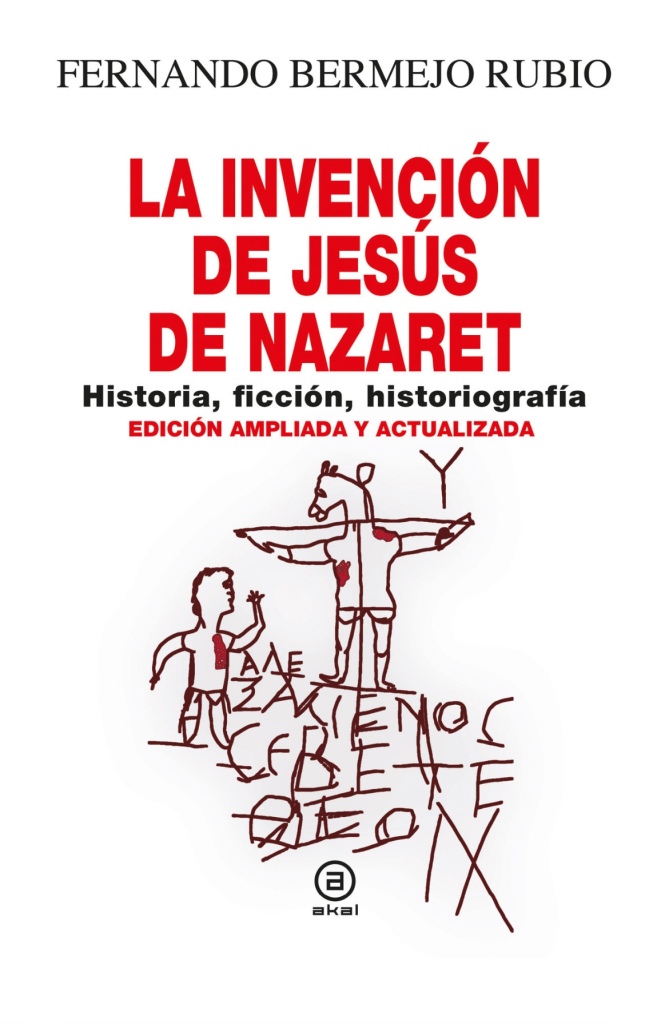
Fernando Bermejo-Rubio used the Alexamenos graffiti on the cover of his book The Invention of Jesus of Nazareth, History, Fiction, Historiography with the following caption:

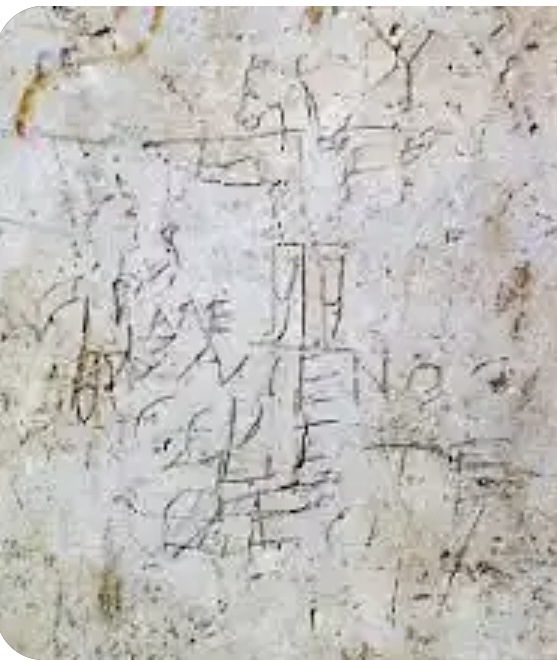
Graphite of Alexamenos (2nd or 3rd century CE), discovered in the Paedagogium of the Palatine (Rome) in 1856. The inscription “ALEXAMENOS SEBETE THEON” means ” Alexamenos worships (his) god.”


In discussing the wider context of this graffiti Bermejo-Rubio goes on to say:

“The mention of the crucifixion is found in the authentic letters of Paul, in Mark, in Flavius Josephus and in Tacitus, and is reflected in the graffiti of Alexamenos of Palatine. … the fact that we have several sources and that among them there are some non-Christian ones increases the probability that they cannot be derived in their original form, from just one independent source. Of all the events related to the life of Jesus, his crucifixion presents the greatest number of testimonies.” [1]

This is also one of the earliest known depictions of the crucifixion. It has a tau cross with hands of the crucified person were tied to the cross beam, and there was a bar to support the feet. [2] As noted by Campbell and Cilliers this was “a remarkable parody from early christianity called the Alexamenos graffito, or graffito blasfemo (ca. 238–244), still captures our imagination today. It was carved in the plaster of a wall near the Palatine hill in Rome and can be seen now in the Palatine Antiquarium Museum. It seems to have been created in the quarters of the imperial pageboys, a boarding school called Paedagogium. In the depiction, one of the boys, obviously a christian, is being mocked by another boy, or by a group of his schoolfellows, by means of parody.”[3] Next to the graffiti is another inscription: Alexamenos is faithful (Alexamenos fidelis). Whether Alexamenos wrote this himself is unknown.

The building that housed this school had been purchased by the Roman Emperor, Caligula, around 40CE and was later changed to a boarding school for Roman noble’s messenger boys. “Alexamenos received his education on the upper floor of a modest two-story building which was tucked among the imposing imperial architecture that crowds the southwest slope of Rome’s Palatine Hill. The Palatine was an exclusive neighborhood in the heart of the city, but even emperors needed space for service workers. … [and] It was here that Alexamenos spent his mornings learning basic numeracy, reading, and writing.”[4]

In the graffiti we have a human with a head of a donkey crucified. Christianity was roundly derided in Rome at this time, and Christians were even accused of practicing Onolatry (donkey worship). It was Minucius Felix that had said, “I hear that they adore the head of an ass, that basest of creatures, consecrated by I know not what silly persuasion—a worthy and appropriate religion for such manners.” (Minucius Felix, Octavius IX). Tertullian defended the christian belief against the charge of a critic who carried around a picture directed against christians with the heading Onocoetes, which means “donkey priest.” The picture featured a man wearing a toga and the ears of a donkey with a book in hand and one leg ending in a hoof (Tertullian, Apology, XVI).

Tertulliam complains of a street entertainer, dressed up with a placard for money- “But lately a new edition of our god has been given to the world in that great city: it originated with a certain vile man who was wont to hire himself out to cheat the wild beasts, and who exhibited a picture with this inscription: The God of the Christians, born of an ass. He had the ears of an ass, was hoofed in one foot, carried a book, and wore a toga. Both the name and the figure gave us amusement.” (Tertullian, Apology XVI).

The donkey became the standard metaphor for stupidity and foolishness in classical antiquity. Cicero, for instance, calls Calpurnius Piso a donkey, someone not capable of being taught letters, and not in need of words, but rather fists or sticks (Cicero, In Pisonem 73.37). Juvenal even talks about a stupid person as a two-legged donkey (Juvenal, Satura 9.92).[5]

As Candida Moss observed “Alexamenos, the caricaturist, and his classmates were not freeborn schoolchildren; they were enslaved members of the imperial family. Family might seem a strange kind of word to use for coerced individuals, but the family (familia) was the social building block of the Roman Empire. The imperial family (or household) incorporated enslaved people and freedmen who were unlikely to have biological ties to the emperor (even if this was a possibility). The room where the students were shaped into copyists, bookkeepers, and secretaries was in truth more a workshop than a school. But like any place of learning, it gave its students brief moments to discuss athletics, create their own sharp hierarchies of status and popularity, and make cruel jokes as only children can.”[6]

The cutting cruelty is not lost on Candida Moss as she shows that crucifixion was all too real for the “enslaved people. Thus, for Alexamenos—as for all enslaved workers in Rome—the cross was both a symbol and a concrete possibility.”[7]

The schoolboy caricaturist even got his grammer wrong as observed by D. Clint Burnett: “The famous Greek graffito from Palatine Hill in Rome (one of the cities famous seven hills) shows a Christian worshiping Jesus drawn as a crucified donkey. The inscription comments on the action of the worshipper, but does so with a grammatical error: ” Alexamenos worships (his) god” (‘Αλεξαμενòς σέβετε θεόν). The graffitist misspelled the Greek verb “worship” (σέβομαι) using a second person plural form “you all worship” (σέβετε) instead of the correct third person singular “he worships” (σέβομαι).” [8]

“The crudely drawn image has the Greek phrase “Ἀλεξάμενος σέβετε θεόν,” with σέβετε being a phonetic misspelling of σέβεται, the ε and the diphthong αι were pronounced the same at this time (MacLean, An Introduction to Greek Epigraphy, 208).” [*]

M. David Litwa also discusses the possibility that the image of the donkey may also have been an image of Seth. Litwa says Seth was frequently described as having the form or skin of a donkey. (Plutarch, Isis-Osiris 362f-363b). Throughout chapter 2 of his book The Evil Creator, Litwa explains hellenised Egyptians started describing Yahweh as having the head of an Ass. Variants of a story are that Antiochus IV discovered the head of an ass at the Temple in 167BC and so it started circulating about the fusing of the form of Seth and Yahweh. (Example: Damocritus, On the Jews; Suetonius, Aug. 40.5. “Jews worshipping donkeys”). Litwa explains the polemic of Yahweh fusing the donkey form of Seth could have been transferred onto Yahweh’s son Jesus in the Alexamenos graffiti. [9]

Another suggestion is the cult of Anubis which was popular could have been used as a polemic too.

And here’s another article on this topic.


[1] Fernando Bermejo-Rubio, The invention of Jesus of Nazareth History, fiction, historiography, Siglo XXI / Serie Historia, 2018), p.109.

[2] Everett Ferguson, Backgrounds of Early Christianity, 3rd ed. (Grand Rapids: Eerdmans, 2003), pp.596–97.

[3] Charles L. Campbell and Johann H. Cilliers,, Preaching Fools, The gospel as a rhetoric of Folly, (Waco Texas: Baylor University Press, 2012), p.2

[4] Candida Moss, God’s  Ghostwriters, Enslaved Christians and the making of the Bible, (London: HarperCollins, 2024), p.23.

[5] Campbell and Cilliers, Preaching Fools, p.4

[6] Moss, God’s Ghostwriters, p.24-5.

[7] Moss, God’s Ghostwriters, p.27

[8] D. Clint Burnett, Studying the New Testament through Inscriptions: An Introduction, (Hendrickson, 2020), ch.1.

[*] The Textual Mechanic, (blog) Tertullian, the Alexamenos Graffito, and P66

[9] L. David Litwa, The Evil Creator, Origins of an Early Christian Idea, (Oxford, 2021), ch.2.

Maranatha

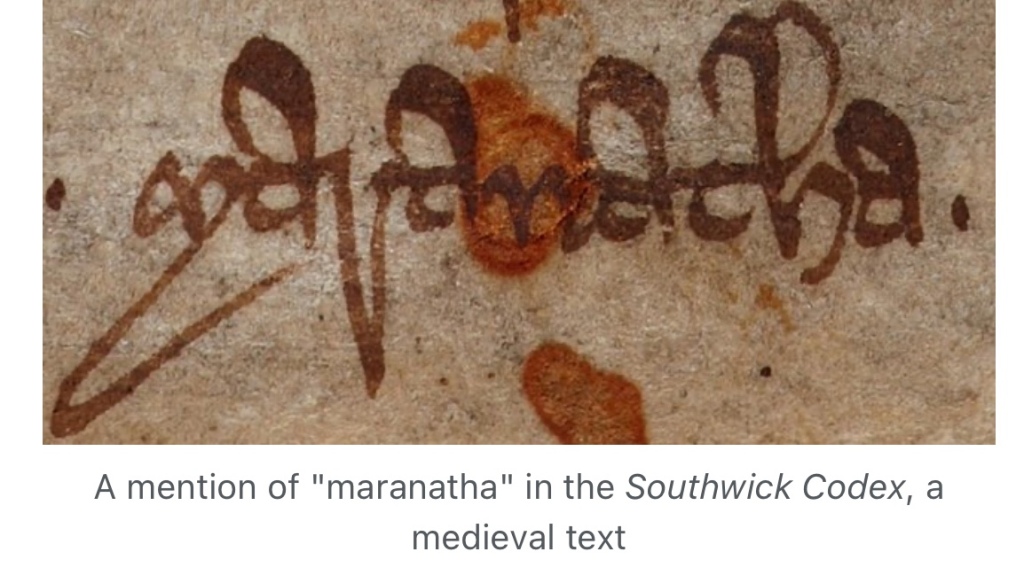
Paul uses an Aramaic phrase in Corinthians, this happens to be a Greek transliteration of the Aramaic expression (Marana tha) used by early Christians. Maranatha (Aramaic: מרנאתא‎) māranā thā. Here is the verse:

If anyone does not love the Lord, let that person be cursed! Come, Lord! Μαράνα θά

1 Cor. 16:22

The amazing thing about Paul using that slogan “Maranatha,” is that it indicates that even those Gentile converts “in-Christ” had enough awareness of the Aramaic speaking movement to make use of that slogan in a language that was foreign to them and to know its meaning.

The meaning of that phrase is a hopeful early return of Christ and a Greek equivalent in Revelation 22:20 “Amen. Come, Lord Jesus!” (Ἀμήν· ἔρχου, κύριε Ἰησοῦ. – Amēn. erchou kyrie Iēsou.) has the same meaning.

This same expression is used in Didache.

If any man is holy, let him come; if any man is not, let him repent. Maran Atha. Amen.

Didache 10:13-14

Hurtado has noted:

It is widely accepted among scholars that we even have a linguistic fragment or actual artifact of the devotional practice of Aramaic-speaking circles of Jewish Christians preserved in 1 Corinthians 16:22. The untranslated expression found here, “Marana tha,” is commonly taken as a prayer or an invocation formula, and is probably to be translated something like “O Lord, come!” It is also now commonly accepted that it was the exalted Jesus who was addressed as the “Lord” in this formula. It is interesting that Paul does not bother to translate the expression here for his Greek- speaking church in Corinth, probably because he expected his readers to recognize it. This is likely because it was one of the devotional formulas from Aramaic-speaking circles of the early Christian movement that he conveyed to his Greek-speaking Gentile converts, as a gesture of their religious solidarity with believers in Judea, whom Paul refers to as predecessors of his Gentile converts (e.g., 1 Thess. 2:13-16; Rom. 15:25-27). Other examples of devotional expressions that derive from Semitic-speaking Christian circles and were circulated by Paul among the congregations that he established include “Abba,” as a devotional expression used to address God in prayer (Rom. 8:15; Gal. 4:6), and “Amen.” To repeat the point for emphasis, the “Marana tha” expression must have been conveyed to Paul’s Greek-speaking converts as already a standardized devotional formula, which confirms that the devotional stance reflected in the expression was a familiar feature of Aramaic-speaking circles of Christians well before the date of 1 Corinthians. [2]

Dunn shows us the eschatological implications of this slogan:

“Paul strongly believed that Jesus’ resurrection and the gift of the Spirit were the beginning (the first-fruits) of the end-time harvest (1 Cor. 15.20,23; Rom. 8.23); and for most of his ministry Paul proclaimed the imminence of the parousia and the end (1 Thess. 1.10; 4.13-18; 1 Cor. 7.29-31). Particularly worthy of notice is his preservation in 1 Cor. 16.22 of an Aramaic cry from the earliest church – ‘Maranatha, Our Lord, come!’. It is scarcely possible that the earliest communities in Jerusalem and Palestine lacked this same sense of eschatological fervour and urgency.” [2]


[1] Larry W. Hurtado, How on Earth Did Jesus Become a God? Historical Questions about Earliest Devotion to Jesus, pp.36-7.

[2] James D G Dunn, Unity and Diversity in the New Testament, An Inquiry into the Character of Earliest Christianity, p.19

Delphi Inscription AKA Gallio Inscription

In the ancient city of Delphi at Mount Parnassus above the Corinthian Gulf in Greece, we find the Temple of Apollo and it was also known for the famous Delphi Oracle. This Oracle known as Pythia (the high priestess) gave prophecies from the Greek God Apollo and was consulted by all sorts of dignitaries such as statesmen, reaching the peak of fame between the 8th and 4th centuries BCE. With the loss of influence by the first century CE, Emperor Claudius issued an edict to prop up an ailing city. This edict is found on a fragmented inscription now known as the Gallio Inscription or Delphi Inscription.

Here is reconstructed edict:

Tiber[ius Claudius Cae]sar Augustus Ge[rmanicus, invested with tribunician po]wer [for the 12th time, acclaimed Imperator for t]he 26th time, F[ather of the Fa]ther[land…]. For a l[ong time have I been not onl]y [well-disposed towards t]he ci[ty] of Delph[i, but also solicitous for its pro]sperity, and I have always guard[ed th]e cul[t of t]he [Pythian] Apol[lo. But] now [since] it is said to be desti[tu]te of [citi]zens, as [L. Jun]ius Gallio, my fri[end] an[d procon]sul, [recently reported to me, and being desirous that Delphi] should retain [inta]ct its for[mer rank, I] ord[er you (pl.) to in]vite well-born people also from [ot]her cities [to Delphi as new inhabitants….][1]


Gallio served a short term as proconsul of Achaia from late 51 AD to 52 AD, and is also known from Roman writings of the 1st and 2nd century such as Cassius Dio, Seneca, and Tacitus. This inscription was written by Claudius who mentions “my friend Gallio the proconsul of Achaia” and is a now a collection of nine fragments, one of which is pictured.

Lucius Junius Gallio Annaeanus or Gallio was a Roman senator and brother of the famous writer Seneca. This same Gallio mentioned in Acts as the one who addressed Paul from the Bema in Corinth (Acts 18:14-16). It is on display at Delphi where it was found in 1905.  Acts has Paul preaching in the 50’s where he is accused before Gallio a proconsul of Achaia. Paul’s epistles also fit right in there in the 50’s from the datable bits of data in them.

Eisenman made some good observations that can be used to date the epistles.[2]

“Greet those who belong to the household of Aristobulus. Greet Herodion, my fellow Jew. Greet those in the household of Narcissus who are in the Lord. (Romans 16:10-11)

Paul greeted all those in the household of Aristobulus. This was a reference to Herod Agrippa’s son. Herodion, or “Little Herod,” is assumed to be the son of Herod of Chalcis.

Douglas Campbell shows Paul’s King Aretus IV incident provides an anchor date for Paul’s epistles in general.[3] It looks like he ran out of Damascenes, but escaped to carry on further missionaries. Richard Carrier shows that Aretas could have briefly held Damascus between 35-37 CE period.[4]

On top of these datable clues the epistles all assume the temple cult is still standing (1 Cor. 3:16-17) and Jerusalem still populated (Gal 1:18); that Judea is not in a war, so they fit right in with the 50’s.

And Paul could only be referring to the Jerusalem Temple here as Jorunn Økland put it:

The statement that the spirit of God dwells in this naos (1 Cor. 3:16-17) is the expression of an idea found in the Hebrew Bible, of God’s kavod, Septuagint Greek doxa, ‘glory’ or ‘honour’ (e.g., Exod 40:34–38; 1 Kgs 8:1–11) dwelling in his sanctuary. In other words, ‘dwelling’ and naos together indicate that Paul links the ekklesia to the temple in Jerusalem. Even if a Greek temple was also thought to host a presence of the deity whose image was worshipped there, the link was far more tenuous because, first, the cult statue itself was the focal point, not the building whose function it was to house it; second, the connection was perceived as less intimate since the same deity could be worshipped under different cult epithets in multiple sanctuaries even in a single city; and, third and finally, the deities of Mediterranean polytheistic systems were frequent travellers, worshipped in numerous sanctuaries across many countries. The God of Israel, by contrast, in the Second Temple period, at least, was thought to dwell in the Jerusalem temple only, although there were different ideas regarding how exactly this dwelling should be understood.[5]

The author of Acts understood Paul preached in the 50’s and this is datable from the epistles themselves. He could therefore weave a story about a known proconsul, Gallio, who was active in early 50’s and today we have found an inscription about the very same Gallio.

Gallio Inscription (ΓΑΛΛΙΩ)

[1] Jerome Murphy-O’Connor, St. Paul’s Corinth: Text and Archaeology (Liturgical Press, 2002),  p.161.

[2] Eisenman, Robert, Paul as Herodian, Journal of Higher Criticism, 3/1 Spring 1996, pp.110-122.

[3] Campbell, Douglas A. “An Anchor for Pauline Chronology: Paul’s Flight from ‘The Ethnarch of King Aretas’ (2 Corinthians 11:32-33).” Journal of Biblical Literature, vol. 121, no. 2, 2002, pp. 279–302.

[4] Carrier, Richard, blog entitled, How Do We Know the Apostle Paul Wrote His Epistles in the 50s A.D.?

[5] Jorunn Økland, “Paul and Sacred Space” in Handbook in Pauline studies, Eds Novenson and Matlock, Oxford 2022, p.566.

Jesus Comparative Figures: Sign Prophet Series (Jesus the Galilean)

Part 9 Jesus the Galilean.

By looking at the other Sign Prophet passages in Josephus works it becomes obvious that Josephus consulted the records under all the various governors of Judea, where footmen or cavalry had to be sent against any mass movement or where any charismatic leader gathered a crowd. Note that the gospel of John (as noticed by Lena Einhorn), reports such an incident where a σπεῖρα (speira), that is a cohort consisting of 500 to 1000 Roman soldiers was sent out and John uses the word χιλίαρχος (chiliarchos), for their commander, this is a commander of one thousand (Jn. 18:3).[1] This suggests just such an incident of footmen were sent out for Jesus, this would generate such a report by the prefect (Pilate), a report that would ultimately be picked up by Josephus. Such incidents were picked up all over the place in Judea for Josephus’ books. (Example Ant. 20.188, War 2.260, Ant. 20.168, Ant. 20.171). Most of the Acta records under each of  the governors of Judea were included in his book Antiquities. Josephus also had help from the imperial secretary Epaphroditus, Josephus even dedicated Antiquities to Epaphroditus. The Roman commander, and later emperor, Vespasian wrote a military memoir, known in Latin as commentarii, and in several cases the use of this source by Josephus is evident. In the words of Louis Feldman:

despite the fact that Josephus does not mention, in his introduction, his use of Vespasian’s and Titus’ commentaries, he must have used them. We may comment that in antiquity it was very often true that an author would name the sources that he should have used, while omitting those he actually did employ. In view of the fact that Josephus was living in Vespasian’s palace while he was writing the work and presumably had access to the Roman archives, it would appear likely that he used the notes of their campaigns in Judea.[2]

The Jewish historian also used the memoirs of King Herod the Great (Ant. 15.174), which were written by Nicolaus of Damascus and he used the correspondence by King Herod Agrippa II. [3] Josephus also had access to the archives that had existed in Jerusalem from Agrippa. King Agrippa seemingly used many acta on behalf of the Jews in his meetings with Caligula in order to emphasize how great the discrepancy was between the intentions of Caligula and the whole tradition of the Roman policy toward the Jews…. Agrippa had the fortune to be able to increase the material, because the archives of Jerusalem were at his disposal. [4] For Josephus reports under Pilate may have referred to a certain ‘Galilean’ in the Roman or Herodian records, (cf Ant. 18.63-64), and here too Josephus would have had to go to the Acta, probably known as the Acta Pilati for his information. (not the Acta Pilati that was forged but an original document that no longer exists).

The Textus Receptus of the the Testimonium Flavianum (TF- i. e. the passage about Jesus in Josephus) has been multiply tampered with but David Allen has shown evidence of an earlier form of this passage (by use of the variants),[5] a passage that would have sounded much more like the Sign Prophet passages that exist in Josephus works. The beauty of the other Sign Prophet passages is that these passages are untampered and give us a real picture of how outsiders viewed them.

In an earlier form of the Testimonium Flavianum (the original TF) (Ant. 18.63-64) Jesus may have been described as a γόης –  goēs prompting Porphyry to describe Jesus as a wizard. In Proof (Dem. Ev.) Eusebius tries to defend against Porphyry’s attacks about Jesus being a wizard. Allen has shown anti-Christian polemicists making use of an original TF.[6] In an earlier form of the Testimonium Flavianum (TF) (the original TF) (Ant. 18.63-64) Jesus fits in with being described as a γόης, the phrase “doer of strange works” fits in with this. The anti-Christian polemicists may have got the impression that Jesus was a γόης (goēs) from the original TF containing παραδόξων. Josephus describes the miracles of the competing magicians at pharaohs court at the time of Moses as a παραδόξα. Celsus picks out that exact word παραδόξων describing Jesus as such in Contra Cels. 1.6.

The Egyptian much like the other Sign Prophets made an incredulous claim that “at his command, the walls of Jerusalem would fall down” (Ant. 20.170). This is similar to Theudas’ incredible claim where by “his own command, divide the river, and afford them an easy passage over it” (Ant.20.97). You could put Jesus’ prophecy of Temple Destruction and Restoration “not made by hands” (Mark 14:58) as among these incredible claims. Many Sign Prophets had gathered a crowd before they got executed, Jesus led two groups to himself before he got executed (Josephus, Ant. 18.63). Dale Allison cannot figure out who the 500 were that Jesus appeared to in his ressurection appearances, ἔπειτα ὤφθη… πεντακοσιίοις ἀδελφοῖς, after that he appeared to…five hundred brothers (1 Cor. 15:6). But then he gives us a hint of who they might be: “with reference to the five hundred, speaks of “brothers” (ἀδελφοί), not “brothers and sisters” (ἀδελφοί καὶ ἀδελφαί),”[7] I bet that these were the remnants of the group that Jesus led in Jerusalem as Allison also said, “Whereas the apostle was writing to people in Greece, the appearance to the five hundred must have occurred in Israel, where surely the majority of surviving witnesses still lived.”[8] In the polemics of the anti-Christians we get a number of 900- Lactantius a Christian writer and an advisor to the first Christian Roman emperor, Constantine I, complains about his interlocutor Sossianus Hierocles: “But he affirmed that Christ, driven out by the Jews, gathered a band of nine hundred men and committed acts of brigandage’ (Lactantius, Divine Institutes, Book v. Ch. 3.).

In the gospels too we get clues of Jesus being a Sign Prophet. Barnett has noted that “Each clearly was a prophet. A ‘Sign’ was attempted by each man [a better nuance of this was a biblical re-enactment]. A significant locale was involved on each occasion and a crowd of people was present. It is striking that Jesus, too, belongs to this sequence. In one notable incident He too was hailed as a prophet who performed an Exodus-Conquest ‘Sign’ (the loaves) in a significant locale (the wilderness) and in the presence of a crowd (Jn. 6. 1-15).”[9] In the words of Gary Greenberg, Jesus’ “ chief disciple, Peter, called him ‘the messiah,’ a title signifying a special King of the Jews [note: the Titulus Crucis] to be sent to Isreal by God in heaven (Matthew 16:16-17). Some of his disciples argued over what role they would play in Jesus’ Kingdom (Mark 10:37). Jesus arranged his entry into Jerusalem in a fashion designed to invoke “messianic allusions” from Jewish scripture (Matthew 21:4)”[10] (A common theme among Sign Prophets was that each would have a vision inspired by scriptures, to do a re-enactment of scriptures hoping God would intervene). John J. Collins sees similarities of the sign prophets to Jesus. In the Gospels, Jesus entered Jerusalem riding on a donkey, to shouts of Hosanna to the Son of David. For the biblically illiterate, Matthew 21:4–5 supplies the quotation from Zechariah 9:9, even providing Jesus with two animals rather than one, missing the Hebraic parallelism. It is certainly tempting to understand this incident in light of the sign prophets in Josephus.”[11] James McGrath shows where the gospels understood both John the Baptist and Jesus preaching the same message. “Matthew takes the similarities further, attributing to John and then Jesus the phrase “brood of vipers” (3:7; 12:34; 23:33) as well as a warning couched in terms of one or more trees being in danger of being cut down (3:10; 7:19). … words about the kingdom of God found on the lips of Jesus in Mark were attributed to John.”[12] This just shows the gospels understood the similarities between these two Sign Prophets, especially as James McGrath argues of John influencing his disciple Jesus. Barnett also notes some of the stories of the gospels could have taken notable events from Jesus public life, events that could just have easily been described by Josephus- “in respect of the ‘feeding’ in the ‘wilderness’ and also of the ‘entry’ to Jerusalem and the accompanying ‘expulsion’ of the merchants from the Temple. It is equally probable that as a ‘public figure’ Jesus was accorded popular support by those who saw in Jesus a political liberator.”[13] Jesus meeting his followers at the Mount of Olives, just as the Egyptian did, would allude to Zechariah and would activate God’s eschatological salvation. But, alas, God stood them up. The gospels come to Jesus’ aid, saying he was not a failure despite the 100% failure rate among the Sign Prophets:

All the sign prophets failed in their endeavours, a promised supernatural intervention failed to materialise, so it is only natural that the gospels would try to explain all this away. Jesus would offer no sign to this generation. (Mk. 8:11-12). “Jesus’ contemporaries … want some sort of proof he is the messiah”, others recognised Jesus should have performed signs but Jesus would not perform for his adversaries. The later Synoptics parallels project the sign of Jonah to this saying, a confirmation from the Tanakh made by the later evangelists that Jesus was ressurected (Mt. 12:39; 16:4; Lk. 11:29) 43. They dissociate Jesus from other sign prophets (Mt. 24:11, 24-26; cf. Mk. 13:22). Yet many memories of Jesus being a prophet reoccur in the gospels. Jesus thought himself a prophet (Mt. 13:57), others thought him a prophet (Mt. 16:14, Jn 7:40, 4:19, Lk. 24:10-21) even those Jesus healed recognised him as a prophet (Jn. 9:17), even crowds proclaimed it (Mt. 21:11). Jesus’ enemies also recognized him as a prophet (Mk. 14:65).[14]

The gospels are very uncomfortable with an obvious Sign Prophet supernatural sign that was promised, that of Temple Destruction and Restoration ‘not by human hands’[15] Thatcher shows how Johns gospels deals with this absurd Sign, and simply spiritualise it, so it does not sound so bad:

John’s understanding of Christian memory is perhaps most evident in the Fourth Gospel’s version of the temple incident, the story of Jesus’ disruption of animal vending and currency exchange in the temple courts during a Passover festival (John 2:13–22). John’s account of this episode portrays “the Jews” demanding a miraculous sign from Jesus to authorize his radical actions. Jesus responds by inviting them to “destroy this temple, and in three days I will raise it” (John 2:19). Here, as elsewhere in the FG, the Jews can only point out the absurdity of Jesus’ proposition: “This temple has been under construction for forty-six years, and you will raise it in three days?!?” The denouncement of this heated exchange is, however, truncated, for the narrator is compelled to break in with an explanation of Jesus’ words: “But he said this about the ‘temple’ of his body. Then when he was raised from the dead, his disciples remembered that he said these things, and they believed the Scriptures and the word that Jesus spoke” (2:21–22). From the perspective of narrative criticism, this explanation is entirely satisfactory, serving as a coherent foreshadowing of John 19:42–20:1. Jesus’ dead body will, indeed, lie in the tomb three days—from the Day of Preparation (Friday) until the first day of the week (Sunday)—before being “raised.”[16]

You can see that Johns gospel spiritualizes Jesus prophecy of Temple Destruction and Restoration. By spiritualising Sign Prophet claims, you counteract the obvious objections of the time, why these signs did not happen. As Thatcher pointed out the Jews from Johns gospel (i e the objections from the time), that the restoration of the Temple in three days was absurd. If you spiritualized all the Sign Prophet signs, these absurd objections disappear- you can explain why the Jordan did not split for Theudas or the walls did not fall for the ‘Egyptian’ or the Temple was not restored for Jesus in three days.

Jesus like other Sign Prophets expected a cataclysmic event to unfold. Many Sign Prophets expected an eschatological divine intervention and many of the earliest strata of the gospels reflect this. “The basic point is this: throughout the earliest accounts of Jesus’ words are found numerous apocalyptic predictions: a kingdom of God is soon to appear on earth, in which God will rule; the forces of evil will be overthrown, and only those who repent and follow Jesus’ teachings will be allowed to enter the kingdom; judgment on all others will be brought by the Son of Man, a cosmic figure who may arrive from heaven at any time.”[17] As Dale Allison has said “Few deny that the eschatological interpretation of the Jesus tradition has brought us much illumination, for it has revealed once and for all that many sayings contain an apocalyptic eschatology.” [18]

Jesus was one in a series of Sign prophets. These sign prophets probably had a vision to re-enacted a great scriptural event, God would intervene and the new age would be initiated by these self proclaimed prophets. (Jesus would have also acted on a vision influenced by scriptures, it’s probably what drove Jesus to do what he did gathering a crowd in Jerusalem resulting in his execution). Josephus would describe these people as pseudo-prophets (as there was a 100% failure rate for all these prophets, Israel would not get restored with God ruling, the opposite would happen where the Temple – Gods house, got destroyed), but in reality they would have been eschatological prophets. To us moderns what the sign prophet tried to initiate would be a scriptural fantasy but to the people back then- they were scriptural realities. By examining all the sign prophets (for example, the ‘Egyptian’, Theudas or the ‘Samaritan’) it becomes apparent that the crowd really believed the sign the prophet promised would really happen. Due to economic distress (such as famines, overtaxation) many of these movements popped up at this time, the Jesus movement was no exception.

What action did Jesus initiate that resulted in his execution? Jesus was one of many that tried to “force the end.” (cf. Song_of_Songs.2.7; Ketubot 111a). That is, begin the new era, in which God would reign – his banner was called, just like many others called it – the Kingdom of Yahweh! Apocalypticism was the worldview of Jesus’ day where people thought that Satan was in charge of the world right now. This worldview developed from oppressed conquered people to explain why terrible things were happening despite the protection of Yahweh. By proclaiming the kingdom of god, Jesus was predicting that this current evil age of Satans hegemony was coming to an end and god would rule in a new age right here on Earth. The narrative of the gospel of Mark is a description of this new age, a kingdom of god is initiated. Jesus resists the temptations of Satan showing Satan no longer in charge, Jesus is able to exorcise to evil spirits that cause sickness. He is able to feed the hungry and even raise the dead. All yearnings of the poor satisfied in the new age. Jesus’ proclamation of a rival kingdom to the Roman administration would have been seen as a threat to Roman security.

Jesus of the synoptic Gospels too may have allowed a sense of his own divine vocation to take him to Jerusalem. it was necessary for the son of Man to suffer (Mark 8:31). The Johannine Jesus claims not to have spoken on his own authority, for “the father who sent me has himself given me a commandment about what to say and what to speak. And I know that his commandment is eternal life. What I speak, therefore I speak just as the father has told me” (John 12:49–50).[19]

In eschatological hope. The group that followed Jesus expected supernatural intervention, they gathered because they really thought God would intervene. Harsh conditions of the peasants made them yearn and believe in the better times promised in the imminent kingdom of God promised. In their apocalyptic view a reversal of fortunes would happen in political power shift initiated by the sign prophet. God would intervene, that walls would come tumbling down, waters would part, sacred vessels would be revealed, the Temple would be Destroyed and restored supernaturally or some other such Biblical re-enactment. This would initiate God’s power struggle as represented by the Sign Prophet.

This line was original to the TF, showing the TF was much like the other Sign Prophets passages:

And when at the indictment of the first men among us, Pilate had sentenced him to a cross

καὶ αὐτὸν ἐνδείξει (endeiksei) τῶν πρώτων ἀνδρῶν παρ᾿ ἡμῖν σταυρῷ (stauro) ἐπιτετιμηκότος (epitetimekotos) Πιλάτου (Pilatou) (Ant. 18.64).

The balanced distinction between  endeiksei (verb endeichnumi) writ of indictment, attributed to Jewish leaders, and the act of awarding sentence (epitiman stauro) is not likely to be the work of a Christian interpolator …Such an interpolator would scarcely have been content with reproaching Jewish leaders for drawing up an indictment against Jesus whilst stating that the imposition of sentence by crucifixion was an act of Roman justice.[20]

The best catch by Schmidt is that Josephus would have been only one step away from people that actually met Jesus at his trial. This is known from the phrase “first men among us” i. e. The Jewish aristocrats including the High Priest party, people belonging to Josephus’ class.[21] These High Priest collaborators had their own spy network to rat Jesus out.[22] The govenors knew through their own spy networks what was going on and easily prevented all these Sign Prophet movements and their plan of action – usually any actions initiated by the Sign prophet had a bad ending.[23]

This authentic line of the original TF matches another comment made by Josephus about another Sign Prophet. As I observered in my latest paper- “Something similar had happened Jonathan the Weaver, “those of the greatest dignity among them informed Catullus, the governor of the Libyan Pentapolis, of his march into the desert, and of the preparations he had made for it.” (War 7.439). This is similar to what happened in the TF, “when at the indictment of the first men among us, Pilate had sentenced him to a cross” (Ant. 18.64).[24]


[1] Lena Einhorn, A Shift in Time, How Historical Documents Reveal the Surprising Truth about Jesus, (Yucca, 2016), Premise Two.

[2] Louis H. Feldman, Josephus, Judaism and Christianity, Introduction, p.24

[3] Jonathan P. Roth, “Josephus as a Military Historian” ch.11 in Chapman and Rodgers (eds), A Companion to Josephus, 2016, p.201.

[4] Willrich,H., Judaica: Forschungen zur hellenistisch-judischen, History, ed. J.H. Hayes, J.M. Geschichte und Literatur, (Gottingen 1900), (supra, note 5), pp. 42-47. Cit op Miriam Pucci Ben Zeev, Jewish Rights in the Roman World, The Greek and Roman Documents Quoted by Josephus Flavius, (Mohr Siebeck, 1998), p.391.

[5] David Allen, “A Model Reconstruction of What Josephus would have Realistically Written About Jesus” JGRChJ 18 (2022), pp.113-43; David Allen, Exposing the Pre-Eusebian strata of the Testimonium Flavianum, JHC 20 forthcoming 2025


[6] Dave Allen, “The Use of the Testimonium Flavianum by Anti-Christian Polemicists”, R M Price, ed., Journal of Higher Criticism 16/1 (Spring 2021), 42-105.

[7] Dale Allison, The Resurrection of Jesus, Apologetics, Criticism, History, (Bloomsberry, 2021), p.74

[8] Allison, Ressurection of Jesus, p.51

[9] P. W. Barnett, “The Jewish Sign Prophets -A.D. 40–70 Their Intentions and Origin”, NTS 27/5 (1981), pp. 679-697, (689).

[10] Gary Greenberg, The Judas Brief: Who Really Killed Jesus?, (NY: Continuum, 2007), p.1.

[11] John J. Collins, “Millenarianism in Ancient Judaism”, in Crossley and Lockhart (eds.) Critical Dictionary of Apocalyptic and Millenarian Movements 15 (2021). Retrieved from: http://www.cdamm.org/ articles/ancient-judaism

[12] James McGrath, John of History, Baptist of Faith, The Quest for the historical Baptiser, (Eerdmans, 2024), p.164

[13] Barnett, The Jewish Sign Prophets, p.693

[14] David Allen, “How Josephus Really Viewed Jesus”, RevBíb 85/3-4  p.348

[15] E.P. Sanders, Jesus and Judaism (Philadelphia: Fortress Press, 1985), pp. 61-76; 

[16] Tom Thatcher, “Why John wrote a Gospel: Memory and History in an Early Christian Community” in Kirk and Thatcher (eds), Memory, Tradition and Text, Uses of the Past in Early Christianity, 2005 SBL, p.82

[17] Bart Ehrman, Great courses, “The Historical Jesus”, p.90 in following link: https://archive.org/details/historical-jesus-bart-d.-ehrman

[18] Dale Allison, Jesus of Nazareth, Millenarian Prophet, p.39

[19] Christopher Rowland, “Apocalypticism and Radicalism” in John J. Collins (ed.), The Oxford Handbook of Apocalyptic Literature, Oxford (2014), p.408

[20] Paul Winter, On The Trial of Jesus, (De Gruyter 1974), p. 40. 

[21] T. C. Schmidt, Josephus and Jesus, pp.6-7.

[22] David Allen, Jesus Realpolitik, JHC 20.2, forthcoming.

[23] see section “3. Spies, Informers, Horsemen and Cavalry!” Of my paper Jesus realpolitik, JHC, forthcoming.

[24] David Allen, “Josephus on Jesus, New Evidence for the one called a ‘certain man’”, JHC 2026 forthcoming.


BACK TO INTRODUCTION


Jesus Comparative Figures: Sign Prophet Series (Jonathan the Weaver)

Part 8 Jonathan the Weaver

David Fiensy noted that leaders of mass peasant movements rarely came from those that were on the bottom rung of social class. “Jonathan the weaver, was an artisan. The survey of leadership of rebellions in the Roman empire, then, is consistent with the findings of modern investigations of peasant societies. Leaders rarely came from peasants themselves.”[1] In Marks gospel Jesus is referred to as a τέκτων – tekton (‘artisan’) (Mark 6:3) although this is often translated as a carpenter, tekton can mean any sort of artisan. I think being from the artisan class would have helped Jesus rise to leadership among the am Ha’aretz. “Josephus tells us of one Jonathan, who, following the Roman victory over Israel and the capture of Jerusalem (70 CE), fled to Cyrene (North Africa). According to Josephus, this man, by trade a weaver, was one of the Sicarii. He persuaded many of the poorer Jews to follow him out into the desert, “promising to show signs and apparitions” (War 7.437–38; Life 424–25).”[2] It is noted that Jonathan had Jewish followers (War 7.438).

Jesus being an artisan helped in his rise, being an exorcist/healer would explain a further exaltation of Jesus among his own people. Jesus would have belonged to a class of charismatic Jews such as Honi or Ben Dosa performing thaumaturgic actions.[3] Jesus’ rise came through his healings where people believed he could overpower Satan affecting people. This would give him the belief that God was with him. Jonathan also being an artisan helped in his rise and a further rise came from being involved with the Sicarii. Jonathan “a final figure appeared in the northern African coastal province of Cyrenaica. A weaver by trade and a refugee whom Josephus associates with the failed Sicarii of Alexandria, Jonathan gained a following among ‘the poor’ (War 7.438), estimated at two thousand elsewhere in Josephus (Life 424). In what is by now a familiar script, he led his followers into the wilderness and promised ‘to demonstrate to them signs and wonders’ (War 7.437). ”[4] Jonathan could be seen as “prophet like Moses” who went with his followers into the desert, preparing them for the restoration of Isreal. Many of the Sign Prophets appealed to the economically oppressed peasants of the time, Jonathan “came thither and prevailed with no small number of the poorer sort to give ear to him;” (War 7.438). There are some indications that there was a more significant element of class conflict in the disturbances created by Jonathan the Sicarius and his followers in Cyrene than in the other cases. …  Josephus specifically states that Jonathan’s followers were drawn from the poor (War 7.438). They were opposed, in the first instance, not by the Roman authorities, but by the “men of rank” among the Jews (7.439)[5] He was against “the wealthiest of the Jews” (7.442), also described as “the well-to-do” (7.445). Greame Lang had noticed that “Jesus himself is recorded as expressing some rather strong opinions about the wealthy. After meeting the rich young man who sadly declines to sell all he has and give the money to the poor, Jesus tells his disciples that “it is easier for a camel to go through the eye of a needle than for a rich man to enter the kingdom of god” (Mark 10:23-25). Many attacks in the Jewish war were carried out by the poor against the upper classes. Ananias’ palace and Herodian palaces were burnt down; all of the debt records were destroyed (War 2.17.6). The Dead Sea Scrolls offer a window into the minds of these Jews and in the scroll 4Q171 describes “the time of testing” doing a pesher on psalm 37. It uses the typology of testing on Exodus and Wilderness. All this together with the reversal of fortunes expected at a realized eschatology meant….. “some of [Jesus’] rhetoric certainly would have been received without much argument by some of the revolutionaries described by Josephus.”[6] Jonathan’s actions were directed not against the Romans, but rather against members of the Jewish aristocracy. If he was a practical revolutionary at all, he might be better described as a social revolutionary than as a political revolutionary.[7] This reminds us of the gospels who appropriated the blame for Jesus’ crucifixion on the Jewish aristocrats (High Priest) instead of on those who carried out the crucifixion- the Romans. Our first Jewish author on Jesus (Paul) blamed his own people for the crucifixion of Jesus by Roman soldiers (1 Thess. 2:15).

Let us now reproduce the passages:

And now did the madness of the Sicarii, like a disease, reach as far as the cities of Cyrene; for one Jonathan, a vile person, and by trade a weaver, came thither and prevailed with no small number of the poorer sort to give ear to him; he also led them into the desert, upon promising them that he would show them signs and apparitions. And as for the other Jews of Cyrene, he concealed his knavery from them, and put tricks upon them; but those of the greatest dignity among them informed Catullus, the governor of the Libyan Pentapolis, of his march into the desert, and of the preparations he had made for it. So he sent out after him both horsemen and footmen, and easily overcame them, because they were unarmed men; of these many were slain in the fight, but some were taken alive, and brought to Catullus.

War 7.437-440

for a certain Jew, whose name was Jonathan, who had raised a tumult in Cyrene, and had persuaded two thousand men of that country to join with him, was the occasion of their ruin; but when he was bound by the governor of that country, and sent to the emperor, he told him that I had sent him both weapons and money. However, he could not conceal his being a liar from Vespasian, who condemned him to die; according to which sentence he was put to death. Nay, after that, when those that envied my good fortune did frequently bring accusations against me, by God’s providence I escaped them all. I also received from Vespasian no small quantity of land, as a free gift, in Judea;

Life 424-25

Josephus goes on in the War to mention his personal involvement with this Sign Prophet. “Jonathan’s name was known to Josephus because of a personal accusation made against Josephus by the Lybian governor Catullus. Josephus is accused along with other prominent Jewish leaders of being implicated in the Jonathan plot (War 7.488).”[8] Because of this personal involvement, Josephus happens to write about Jonathan in autobiography, the passage is reproduced above in his book VitaeLife. After Jonathan’s arrest, Jonathan conspired with the Roman governor Catullus to accuse aristocrats Jews and Josephus himself in being implicated in the plot (War 7.488). Part of this accusation is that Josephus provided weapons to Jonathan’s movement, but this looks like a false accusation (on both accounts, Josephus being involved and weapons provided). In the next months, governor Catullus used Jonathan to incriminate several important Jewish men, but the new emperor, Vespasian,  grew suspicious and in the end, Catullus was reprimanded and Jonathan was burned alive.[9] The earlier account of this narrative looks like the more accurate assessment that this movement was not armed (too poor to arm). We see in the case of Jonathan (same as the Baptist) his followers were unarmed. As noted by Nathan C. Johnson: In the groups discussed here, such salvation, as we shall see, never arrived, and Rome violently put down these gatherings. In light of this iron-fisted response, the question arises whether or not these movements had violent intentions. Though a handful of sign-prophet gatherings were armed, these movements were not all violent per se, and Josephus even notes that some of the slain throngs were “unarmed”.[10]

 I will also reproduce the plot Josephus reports about his involvement with Jonathan:


As for Jonathan, the head of this plot, he fled away at that time; but upon a great and very diligent search, which was made all the country over for him, he was at last taken. And when he was brought to Catullus, he devised a way whereby he both escaped punishment himself, and afforded an occasion to Catullus of doing much mischief; for he falsely accused the richest men among the Jews, and said that they had put him upon what he did. Now Catullus easily admitted of these his calumnies, and aggravated matters greatly, and made tragical exclamations, that he might also be supposed to have had a hand in the finishing of the Jewish war. But what was still harder, he did not only give a too easy belief to his stories, but he taught the Sicarii to accuse men falsely. He bid this Jonathan, therefore, to name one Alexander, a Jew (with whom he had formerly had a quarrel, and openly professed that he hated him); he also got him to name his wife Bernice, as concerned with him. These two Catullus ordered to be slain in the first place; nay, after them he caused all the rich and wealthy Jews to be slain, being no fewer in all than three thousand. This he thought he might do safely, because he confiscated their effects, and added them to Caesar’s revenues. Nay, indeed, lest any Jews that lived elsewhere should convict him of his villainy, he extended his false accusations further, and persuaded Jonathan, and certain others that were caught with him, to bring an accusation of attempts for innovation against the Jews that were of the best character both at Alexandria and at Rome. One of these, against whom this treacherous accusation was laid, was Josephus, the writer of these books. However, this plot, thus contrived by Catullus, did not succeed according to his hopes; for though he came himself to Rome, and brought Jonathan and his companions along with him in bonds, and thought he should have had no further inquisition made as to those lies that were forged under his government, or by his means; yet did Vespasian suspect the matter, and made an inquiry how far it was true. And when he understood that the accusation laid against the Jews was an unjust one, he cleared them of the crimes charged upon them, and this on account of Titus’s concern about the matter, and brought a deserved punishment upon Jonathan; for he was first tormented, and then burnt alive.

War 7.441-450

To  Johnson this movement looked millenarian:

As happened previously in Alexandria, however, Jewish men of rank reported his activity to the Roman-appointed governor (Catullus), who quashed the unarmed multitude with cavalry and infantry. Jonathan temporarily escaped but was later apprehended, used as an informant, tortured, and eventually burned alive in Rome at the command of Emperor Vespasian (War 6.450). Again, the promise of thaumaturgical proof of God’s support lends the movement to millenarian categorization. Despite Jonathan’s alleged association with the Sicarii, the unarmed status of his adherents marks this as yet another ‘assaulted’ millenarian group (though cf. Life 424–25, where Jonathan accuses Josephus of supplying ‘arms and money’ to the movement). Rome was once again the aggressor, preemptively stamping out perceived threats. That a millenarian ideology associated with nativism and restorationism could gain traction outside Judea is of interest, intimating how durable, attractive, and adaptable the millenarian impulse could be among an oppressed religious group.[11]

Here is another interesting similarity to Jesus, where both movements were ratted out from the upper class Jewish spy network. An extract from my latest paper:[12]

The best catch by Schmidt is that Josephus would have been only one step away from people that actually met Jesus at his trial, this is known from the phrase “first men among us” i. e. The Jewish aristocrats including the High Priest party, people belonging to Josephus’ class. These High Priest collaborators had their own spy network to rat Jesus out.[13] Something similar had happened Jonathan the Weaver, “those of the greatest dignity among them informed Catullus, the governor of the Libyan Pentapolis, of his march into the desert, and of the preparations he had made for it.” (War 7.439). This is similar to what happened in the TF, “Pilate, on the accusation of the first men among us, condemned him to be crucified” (Ant. 18.64)


BACK TO INTRODUCTION


[1] David Fiensy, Leaders of Mass Movements and the Leader of the Jesus Movement, JSNT 74, pp.3-27 (12).

[2] Craig Evans, ch 2 in Amy-Jill Levine et al (eds) Jesus in Context, p.59

[3] Gaza Vermes, Jesus the Jew, chapter 3, especially p.58 and 69; Honi the Circle-Drawer by the rabbis (y. Taanit 16a–b;  b. Taanit 19a; 23a) and Onias the Righteous by Josephus. (Antiquities 14.2.1-21). Hanina Ben Dosa (example Ta’anit. 24b–25a; Berakhot 34b.

[4] Nathan C. Johnson, (2021) “Early Jewish Sign Prophets” in James Crossley and Alastair Lockhart (eds.), CDAMM retrieved from here: https://www.cdamm.org/assets/articlePDFs/31519-early-jewish-sign-prophets.pdf

[5] Rebecca Gray, Prophetic Figures in Late Second Temple Jewish Palestine, The Evidence from Josephus, Oxford 1993, p.135

[6] Greame Lang, “Oppression and Revolt in Ancient Palestine: The Evidence in Jewish Literature from the Prophets to Josephus”, Sociological Analysis 49/4 (Oxford, 1989), pp. 325-342, first quote at 327, second quote at 329.

[7] Gray, Prophetic Figures, p.139

[8] David Allen, “How Josephus Really Viewed Jesus”, RevBíb 85/3-4, p.339.

[9] Johnson, Early Jewish Sign Prophets.

[10] Johnson, Early Jewish Sign Prophets

[11] Johnson, Early Jewish Sign Prophets.

[12] David Allen, Josephus on Jesus, New Evidence for the One called a ‘certain man’, JHC forthcoming.

[13] T. C. Schmidt, Josephus and Jesus, pp.6-7.

[14] David Allen, Jesus Realpolitik, JHC 20.2, forthcoming.