Jesus wanted to “Force the end”!

it is a matter of belief that in a dream impressions have been brought before the minds of many, some relating to divine things, and others to future events of this life, and this either with clearness or in an enigmatic manner — a fact which is manifest to all who accept the doctrine of providence.

Origen, Contra Celsum 1.48

Most actions instigated by eschatological prophets started with a vision inspired by scriptures. The promises the ‘Egyptian’ (Ant. 20.170) and Theudas (Ant. 20.97) made, the uncomfortable prophecy Jesus made on Temple Destruction and Restoration, all make this clear.

What action did Jesus initiate that resulted in his execution? In my last blog I show that Jesus was one of many eschatological prophets. In this blog and on the back of my latest research I show that Jesus was one of many that tried to “force the end.” (cf. Song_of_Songs.2.7; Ketubot 111a). That is, begin the new era, in which God would reign – his banner was called, just like many others called it – the Kingdom of God! Apocalypticism was the worldview of Jesus’ day where people thought that Satan was in charge of the world right now. This worldview developed from oppressed conquered people to explain why terrible things were happening despite the protection of Yahweh. By proclaiming the kingdom of god, Jesus was predicting that this current evil age of Satans hegemony was coming to an end and god would rule in a new age right here on Earth. The narrative of the gospel of Mark is a description of this new age, a kingdom of god is initiated. Jesus resists the temptations of Satan showing Satan no longer in charge, Jesus is able to exorcise to evil spirits that cause sickness. He is able to feed the hungry and even raise the dead. All yearnings of the poor satisfied in the new age. Jesus’ proclamation of a rival kingdom to the Roman administration would have been seen as a threat to Roman security.

Allison sees Mark 1:14-15 as a mixed source of a remembered tradition of Jesus and what the evangelist redacted. “Mark tells us that Jesus came into Galilee proclaiming the good news of God and saying, “The time is fulfilled, and the kingdom of God has come near; repent, and believe in the good news” (1:14–15). What do we make of this unit? Many now reasonably ascribe it to Markan redaction. But those of us who believe that Jesus (a) taught in Galilee, (b) thought that the time of Satan’s rule was coming to its end, (c) proclaimed the imminence of the kingdom of God, (d) called for repentance, and (e) associated his ministry with the prophecies of Deutero-Isaiah might well regard Mark 1:14–15 as a fair summary of Jesus’ proclamation. So even if it is redactional and not from Jesus, it rightly remembers some things and so is a witness to who he was.”[1] Much of what Allison sees in the gospels are a memory of Jesus’ death as an eschatological event. “if we have memory in the tradition, then the first and most likely place to look for it is not in individual sayings that our traditional criteria seemingly endorse but in themes and motifs—as well as in rhetorical strategies such as the use of parables and hyperbole — that recur across the sources.”[2] One reoccurring theme is Jesus beating Satan, the gospels as describing the new age already started. Jesus defeats Satan in the temptation scenes Mark1:12–13; Matt 4:1–11 = Luke 4:1–13, in his exorcisms Mark 1:21–28; 5:1–20; 7:24–30; 9:14–20; Matt 12:22–23 = Luke 11:14, Matt 9:32–34 and even a vision of Satan falling Luke 10:18.

Another messianic figure – Judas the Galilean, also wanted to establish a kingdom of god. He told his followers ‘they were cowards if they would endure to pay a tax to the Romans, and would, after God, submit to mortal men as their lords’ (War2.118) and his movement would only accept ‘that God is to be their only Ruler and Lord.’ (Josephus, Ant. 18.23). Jesus initiated some action to achieve the Kingdom of God and that got him crucified. Like many of the Sign Prophets, Jesus gathered a crowd and was thus seen as a threat to Roman security. Jesus would have received some mystical vision, a vision of what to do to force the end. Usually what the vision involved was some re-enactment of scripture, this is what happened to Theudas and the ‘Egyptian’ both re-enacting a scriptural event and expecting Yahweh to intervene. The ‘Egyptian’ claims to make the “walls come tumbling down” (Ant. 20.170) in Jerusalem which is a clear allusion to the battle of Jericho (Joshua 6:20). Theudas’ claim to be able to divide the river (Ant. 20.97) is a clear allusion to Joshua 3.14-17, which has everything to do with the redemption of Israel. What drove Jesus to Jerusalem was probably a vision that involved a similar re-enactment of scripture that would “force” Yahweh to intervene and achieve an eschatological moment in time!

This was a time where dreams and visions were thought to be a meeting with the divine.

The bible itself relates dreams, visions, auditions, and the conviction that (to quote)
“When there are prophets among you, I the Lord make myself known to them in visions; I speak to them in dreams. not so with my servant Moses; he is entrusted with all my house. With him I speak face to face, clearly, not in riddles; and he beholds the form of the Lord.” (Numbers 12:6–8)
In the New Testament Paul’s opening words at the beginning of his letter to the Galatians appeal to an “apocalypse” rather than human authority (Gal 1:1–16). The Jesus of the synoptic Gospels too may have allowed a sense of his own divine vocation to take him to Jerusalem. it was necessary for the son of Man to suffer (Mark 8:31). The Johannine Jesus claims not to have spoken on his own authority, for “the father who sent me has himself given me a commandment about what to say and what to speak. And I know that his commandment is eternal life. What I speak, therefore I speak just as the father has told me” (John 12:49–50).[3]

– Christopher Rowland

More than likely Jesus like other sign prophets from the time, tried to “force the end” as the Talmud describes it, by some scriptural re-enactment. The Scriptures inspired Jesus’ vision (See my quote below). It is obvious the gospels see that Jesus expected a Yahweh intervention.  Mark 14:57-58 shows the gospels uncomfortable because of the failed prophesy that the Temple would get rebuilt “not made” with human hands. This is beyond the rational realm and in line with what other sign prophets expected- god to intervene. What he got was what other sign prophets got, hunted down to be executed. Many Sign prophets of this era re-enacted some special scriptural event, thinking that Yahweh would intervene and initiate a new age. This is what was hoped for by Theudas and the ‘Egyptian’. They re-enacted scriptural events hoping Yahweh just like the old days would intervene and initiate a new age. “Later during the governorship of Cuspius Fadus (44–46 CE), Theudas caused a similar commotion [to Judas the Galilean], as he promised to split the Jordan River and lead his followers into freedom.[4] Why this could be “categorised as “millenarian” is because it envisaged radical transformation through a dramatic action by tapping into well-known themes from Jewish ancestral traditions about Moses”.[5] The ‘Egyptian’ promised the walls of Jerusalem would come tumbling down, a clear allusion to Josh 6. In “key moments in the birth of the nation, these signs prophets signalled the eschatological nearness of final redemption.”[6] As can be adduced, we have evidence of other eschatological prophets that also risked their lives, mostly like Jesus ending up in their executions as well. Rome got tough with those that gathered crowds.

Here is the relevant quote from my new paper:

Hengel noted in rabbinic literature centuries later that we have rabbis who disapprove of sign prophets who attempted to force the end.[7] R. Helbo is reported to have said: “They must not force the end; when they return from exile, they must not return home in huge mobs; they must not rebel against the empire; and they must not reveal its mysteries”[8] R. Zeira reports : “That [those who know] should not reveal the end of days; and that they should not distance the end of days [saying that it is still far away][9] Peter Schäfer’s main thesis in his book, Jesus in the Talmud shows that most mentions of Yeshu referred to different figures at different times, but these same figures were used as sophisticated counternarratives to the gospels and could have preserved an understanding of Jesus by the Jews.[10] In one such counter-narrative Simon J Joseph noted that the Babylonian Talmud (Sanh. 43a), Yeshu was “one who leads the people astray.”[11] That Yeshu was accused of witchcraft and Josephus often described the Sign Prophets as goētos (“charlatan/magician”)[12]

– David Allen, How Josephus Really viewed Jesus, RevBíb 85/3-4, (2023) page 349.

Novenson claims that some of the bandit-kings in Josephus would “have been hailed as messiahs, as the Judean bandit-king Shimon bar Kosiba was during the reign of Hadrian.”[13] In one account he compares “Josephus’s Roman-facing account with an inner-Jewish report preserved in the rabbinic midrashim. Eleazar ben Dinai, a mid-first-century CE Judean rebel who was eventually apprehended and extradited to Rome by Antonius Felix, Josephus calls τόν τε ἀρχιλῃστὴν Ἐλεάζαρον ἔτεσιν εἴκοσι τὴν χώραν λῃσάμενον, “Eleazar the bandit- chief who ravaged the country for twenty years” (War 2.253; cf. War 2.235–36; Ant. 20.121, 161). The late antique Song of Songs Rabbah, on the other hand, remembers this same Eleazar— alongside Amram, Shimon bar Kosiba, and Shuthelach ben Ephraim— among “the four generations who tried to hasten the end and came to grief.”[14]

To fully grasp the historical context of Jesus’ time I have done a comparative study with other Sign Prophets and show that Jesus’ descriptions and actions in the Christian literature have all the hallmarks of the other Sign Prophets. Collins sees Jesus triumphal entry into Jerusalem has the hallmarks of the Sign Prophet gathering crowds. [COLLINS “Millenarianism in Ancient Judaism”. Retrieved from http://www.cdamm. org/articles/ancient-judaism]. The prediction attributed to Jesus that the Temple would be destroyed and rebuilt not with human hands belongs in the realm of Sign Prophet promises, and eschatological signs. (Mark 14:58-58).

Here are the highlights of my paper, to give you an idea what drove these people to do what they did, and thus what most likely drove Jesus to do what he did.

From page 341-

John the Baptist use of the Jordan River may have evoked Elisha’s command to Naaman to immerse (ebaptisato) himself seven times in the Jordan in order to be purified of his lepra (2 Kings 5:14 Septuagint [hereafter LXX]). Second, it is possible that people would have associated John’s actions with some form of eschatological entrance into the land of promise, since Joshua led Israel through the Jordan in order to possess the land (Josh. 3:15; LXX uses the verb in reference to the priests entering into the water of the Jordan).[15]

From page 342-

The Samaritan sign prophet decided to show the crowd sacred vessels buried by Moses on the sacred site of Mount Gerizim, the site where the Hasmoneans had destroyed the Samaritan’s sacred Temple (Ant.18.85–87). The vessels were probably instruments used for Temple duties and would connect this Samaritan figure to Moses. (Deut. 27. 1-2). As a side note the gospel of Mark portrays “Jesus as refusing to allow “anyone to carry a vessel through the Temple,” alluding to Zech 14:20. Jesus not allowing anyone to carry “anything” through the Temple seems to refer to sacred vessels – skeuos (Mk 11.16).[16]

With the Sign Prophets under Felix Josephus makes a distinction from the Sicarii, hinting at the Sign Prophets religious fervor, they were “not so impure in their actions” (War 2.258). These sign prophets were distinctive in that they all “led their followers into (anticipated) participation in some great liberating action by God.”[17] The sign prophet under Festus “promised them deliverance and freedom from the miseries they were under” (Ant. 20.188).

From page 343-

The Sign Prophet at the Temple in 70CE promising deliverance in the midst of Roman slaughter just shows in desperate times how scriptural fantasy offered false hope. (War 6.283). Hengel sees the Temple Sign Prophet as one of many appointed by the Zealots to boost peoples morale among the horrors suffering from Roman siege warfare.[18]

Jesus was going to force the end, if Yahweh had intervened as Jesus expected, then he would not have gotten executed. “I have come to bring fire on the earth, and how I wish it were already kindled!” (Luke 12:49). So I don’t think Jesus expected to die. Yet he also probably knew the risks. I see Jesus as trying to “force the end”, to initiate a new kingdom of God. What Jesus got was not what he expected. Mark quoting the psalm has preserved this- “My god my god why have you forsaken me!” … (Jesus dying for our sins is a later apology to why Jesus got executed shamefully). Instead of a Yahweh intervention, what Jesus got was executed as he was a threat to Roman security. He was not the only eschatological prophet of this time, he was not the only one who tried to “force the end”, he was not the only one who threatened Roman security and he was not the only one caught and executed.

Hope you have enjoyed this taster from my new paper. I will close out this blog with a quote from Dale C. Allison:

We know far too little about the so-called sign prophets in Josephus, but it is credible that at least the so-called Egyptian (Ant. 20.169–72; War 2.262–63) or the Samaritan who led armed men to Mount Gerizim (Ant. 18.85–87) was in the grip of an eschatological scenario. Beyond them, some who participated in the revolt against Rome in the 60s CE must have believed that the prophecies of Daniel were unfolding in their day (cf. Josephus, Ant. 10.268; see Hengel 1989: 229–312), and that the apocalypse was to hand. Tacitus was under the impression that, around the time of the Jewish war, most Jews “were convinced that the ancient scriptures of their priests alluded to the present as the very time when the Orient would triumph and from Judaea would go forth men destined to rule the world” (Hist. 5.13; cf. Josephus, War6.312).[19]

Dale C. Allison.

[1] Dale C Allison “Traditional Criteria of Authenticity” in Tom Holmén and Stanley E. Porter. (eds) Handbook for the Study of the Historical Jesus, Volume 1, How to Study the Historical Jesus (Leiden:Brill: 2011), pp.13-14.

[2] Allison, ibid, p.25

[3] Christopher Rowland, “Apocalypticism and Radicalism” in John J. Collins (ed.), The Oxford Handbook of Apocalyptic Literature, Oxford (2014), p.408

[4] OLIVER, “Are Luke and Acts Anti-Marcionite? ” , in J. H. Ellens – I. W. Oliver, et al (eds.), Wisdom poured out like water: studies on Jewish and Christian antiquity in honor of Gabriele Boccaccini, series: Deuterocanonical and cognate literature studies 38, Boston 2018, p.508.

[5] CROSSLEY AND MYLES, Jesus: A Life in Class Conflict, p.4-5 (5).

[6] FREDRIKSEN, When Christians Were Jews, p.177f.

[7] Martin Hengel, The Zealots, Investigation into the Jewish Freedom Movement in the Period from Herod I to 70 AD (translation by David Smith), Edinburgh 1989, p.124.

[8] J. T. Townsend, Midrash Tanhuma Appendix to Devarim, Siman 3 on Song of Songs 2:7, S. Buber Recension, 1989. Available online: https://www.sefaria.org/Song_of_Songs.2.7?lang=bi&p2=Midrash_Tanchuma_Buber%2C_Appendix_to_Devarim.3.1&lang2=bi

[9] Steinsaltz, R. A., Koren Talmud Bavli (The Noé Edition), Jerusalem 1965, 2019, Ketubot 111a.

[10] Schäfer, P., Jesus in the Talmud, Princeton, NJ 2007, pp. 8-10

[11] Joseph Simon, J., Jesus and the Temple, The Crucifixion in its Jewish Context, Cambridge 2016, p. 21

[12] Barnett, P. W., “The Jewish Sign Prophets – A.D. 40-70, Their Intentions and Origin”, NTS 27 (1988), p.681.

[13] MATTHEW V. NOVENSON, The Grammar of Messianism, An Ancient Jewish Political Idiom and Its Users, Oxford, 2017, p.144

[14] Novenson, ibid, p.144, fn.114; Song Rab. 2.7.1, trans. Maurice Simon, Midrash Rabbah, vol. 9 (London: Soncino, 1983).

[15] THEISSEN, Forces of Death, p.23

[16] JOSEPH, Jesus and the Temple, p.115

[17] HORSLEY, “Popular Prophetic Movements”, p.8.

[18] HENGEL, Zealots, p.229

[19] Allison, “Apocalyptic Ethics and Behavior” in John J. Collins (ed.), The Oxford Handbook of Apocalyptic Literature, Oxford (2014), p.308.


Jesus wanted to “Force the end”! (Cover picture from Elaine Pagels book Beyond Belief).

The Original TF embedded in the Slavonic?

This is an experimental post, and I have shown in previous posts, the Slavonic dropping Jesus’s name shows that it used a source that came from a Greek examplar before Eusebian tampering. I show that in many posts eg here and here.

The Russian chronographer who wrote the Slavonic translated and adapted Josephus War book. It was not a strict translation, he was known to expand especially when it came to battles and fighting. He was highly educated and had many sources such as the Byzantine historians Hamartolus and Malalas.[1] On top of those Byzantium historians I find another source has influenced the TF insertion to the Slavonic. In agreement with John Curran a different transmission line of the TF went east[2] and this particular manuscript most likely influenced the TF insertion into the Slavonic. The reason for this is that it is difficult to explain why the Slavonic dropped the name Jesus and title Christ if this passage derived from the same TF that was tampered by Eusebius. A pre-Eusebian manuscript that went east would explain why the name Jesus was dropped in the exact Slavonic TF passage. The explanation is simple – the name Jesus was not in this particular source. In my latest paper I discuss the exact same thing has happened to the Slavonic Baptist passage- John also was not named in the exact Slavonic Baptist passage making it extremely likely John was also not named in a manuscript source for the Slavonic! This is normal for Josephus as most Sign Prophets were not named either. [3]

Here is a quote from my paper on these exact points: [4]

Meschersky (Mečerskij) is at a loss of why the Slavonic dropped Jesus’ name in the exact TF passage and merely asserts unconvincingly that it was to make it less Christian, unlikely given how Christian the passage already is. [14] Josephus sometimes named the Sign Prophets, on Meschersky’s assertion it makes no difference whether Josephus named Jesus or not to make the passage more authentic. As observed by Kate Leeming, “Jesus is rarely referred to by name … elsewhere he is the “wonderworker” or the “king who did not reign” or some other term. Why would a Christian be reticent about naming Jesus?” [15] The Slavonic also does not have John the Baptist named in the exact passage inserted into the Slavonic War, simply referring to him as the Baptist. [16] Again, dropping the name John from a source text used by the Slavonic does not make sense unless the source was from a more primitive version of Antiquities that did not have the Baptist named and was used for the insertion.

[14] LEEMING H. – LEEMING K. (eds.), Slavonic Version, p.19. [15] LEEMING K., “The Slavonic Version of Josephus’s Jewish War”, p.395. [16] LEEMING H. – LEEMING K. (eds.), Slavonic Version, p.248.

Now let us reproduce the Slavonic TF, here I will have in bold type what may have come from the original TF.

At that time there appeared a certain man, if it is proper to call him a man, whose nature and form were human but whose appearance was more than human and whose deeds were divine. And he worked wonderful and powerful miracles. Therefore it is impossible for me to call him a man. Then again, in view of his common nature, I shall not call him an angel [either].

And everything, whatever he did, he did by some unseen power, by word and command. Some said of him: Our first lawgiver has risen from the dead and has been demonstrating many cures and skills. Others thought that he was sent from God. But he was in much opposed to the law and did not observe the sabbath according to the ancestral customs, yet did nothing dirty, unclean, nor with use of hands, but worked everything by word only. And many of the people followed and listened to his teachings.

And many souls were aroused, thinking that by him the Jewish tribes would free themselves from the hands of the Romans. But it was his habit rather to remain in front of the city on the Mount of Olives; and there he also [freely] gave cures to people. And there 150 servants and a multitude of people joined him, seeing his power, how by word he did everything he wished. They bade him enter the city, kill the Roman troops and Pilate, and reign over these. But he did not care [to do so].

Later, when news of this came to the Jewish leaders, they assembled to the chief priests and said: We are powerless and [too] weak to oppose the Romans, like a slackened bow. Let us go and inform Pilate what we have heard, and we shall be free of anxiety; if at some time he shall hear [of this] from others, we shall be deprived of property, ourselves slaughtered, and [our] children exiled. And they went and informed Pilate. And he sent and killed many of the people and brought in that wonderworker. After inquiring about him Pilate understood that he was a doer of good, not of evil, [and] not a rebel, nor one desirous of kingship; and he released him. For he had cured his wife, who was dying.

And he went to the usual places and performed his usual deeds. And again, as more people gathered around him, he became renowned for his works more than all [others]. Again the lawyers were struck with envy against him. And they gave 30 talents to Pilate that they should kill him. And he took [it] and gave them liberty to carry out their wishes themselves. And they sought out a suitable time to kill him. For they had given Pilate 30 talents earlier, that he should give Jesus up to them. And they crucified him against the ancestral law, and they greatly reviled him.

Slavonic TF

Now for fun let us put the bold type together and turn the italic bold to positive.

At that time there appeared a certain man There 150 servants and a multitude of people joined him, seeing his power, how by word he did everything he wished. And many souls were aroused, thinking that by him the Jewish tribes would free themselves from the hands of the Romans.Some thought he was a rebel desirous of kingship. When news of this came to the Jewish leaders they went and informed Pilate. And he sent and killed many of the people and brought in that wonderworker and crucified him.

Embedded Original TF

Now compare this to other types of passages Josephus wrote about other Sign Prophets and you will see this is exactly the type of passage that Josephus would have wrote.


[1] For a good examination of this: LEEMING, H and LEEMING, K, eds, The Slavonic Version of Josephus’s Jewish War, A Synoptic Comparison of the English Translation by H. ST. J. THACKERAY with the Critical Edition by N. A. MEŠČERSKII of the Slavonic version in the Vilna manuscript translated into English by H. LEEMING and L. OSINKINA in Arbeiten Zur Geschichte Des Antiken Judentums und des antigen Judentums und des Urchistentums 46, Boston: Brill 2003.

[2] CURRAN, “Be or to Be Thought to Be”: The Testimonium Flavianum (again) “, Novum Testamentum, 59/1, (2017), 71-94.

[3] Allen, “How Josephus Really Viewed Jesus”, RevBib 85/3-4, 333-358. See also Leeming and Leeming, ibid, p.248-249.

[4] Allen, ibid, 338. also note for footnote 15, I used Leeming , K., “The Slavonic Version of Josephus’s Jewish War”, in Chapman–Rodgers (eds.), A Companion to Josephus, Oxford 2016, 390-401.

Jesus Group Armed or not?

My latest peer review paper does a comparative study of other Sign Prophets to Jesus and their respective movements. It reveals some pretty interesting results. One result was the type of movements these were, what were the driving forces. Both the apocalyptic worldview, visions and scriptural re-enactments were all attributes of these movements. What they hoped to achieve (by some scriptural re-enactment) was to force the imminent kingdom of God in a new age and a reversal of fortunes for the oppressed suffering peasants. “Some of these movements were armed, some were not, so whether the groups of people Jesus led before his execution (Ant. 18.63) were armed or not, his movement can be seen in light of sign prophet movements.” [1] The gospel of Luke does suggest the Jesus group was lightly armed:

according to Luke’s Gospel, Jesus tells his followers: “The one who has a purse must take it, and likewise a bag. And the one who has no sword must sell his cloak and buy one.” . . . They [the disciples] said, “Lord, look, here are two swords.” He replied, “It is enough” (22:36–38). Their response indicates that they are already armed.[2]

According to Brandon, Jesus had been sanitized in the gospels, he works from the premise that Jesus got “crucified by the Romans as a rebel against the government in Judea.”[3] Even though Jesus was whitewashed and changed beyond recognition there were some fossils, stories about the historical Jesus that just made it into the gospels. These incidents escaped the censorship editors such as the disciples armed with weapons starting to defend him against the arresting mob in Gethsemane. Jesus asked at the last supper have you got any swords. The kingdom of god advances with violence, Jesus saying “I have not come to bring peace, but a sword” (Matt. 10:34) and many other such incidents.

So we find the movement bringing swords into Jerusalem. Jesus accused of making threats to the temple. “I have come to bring fire on the earth, and how I wish it were already kindled!” (Luke 12:49). Gospel of Peter says they were attempting to start fires at the temple. “we were in hiding, for we were sought after by them as wrongdoers and as wishing to set fire to the sanctuary” (Gospel Peter 26). The curtain was torn (Mark 15:38). Jesus flipping over tables, striking with weapons (John 2:13). Caiaphus’ servant got his ear cut off, the ring-leader is arrested and swiftly executed. The band disperses and regroups back in rural Galilee. Texts later arise that sought to sanitize all that. The gospel of John uses the word σπεῖρα (speira), that is a cohort consisting of 500 to 1000 Roman soldiers and the word χιλίαρχος (chiliarchos) for their commander, this is a commander of one thousand. (John 18:11). Why so many to arrest Jesus? The Barabbas incident suggests a rebellious background. In Mark 15:7, “στάσει” means rebellion or insurrection. The Greek text has insurrectionists [plural] that committed murder, not just Barabbas alone. In historical context as seen in Josephus, the number of rebels the gospels allude to would have been substantial.

In the same tradition of Brandon, Bermejo-Rubio thinks that a pacifist layer was added by the gospels, that the original layer covered up was that Jesus was some sort of zealot rebel. “Put away the sword”, “turn the other cheek”, “all they that take the sword shall perish with the sword”, are all sayings resisting violence. That the gospels all have Jesus resisting violence yet still let it out that Jesus was crucified between two insurrectionists and notes that these may have been followers.[4]

On the other side of the argument Simon J. Joseph says we cannot privilege one set of violent sayings over another set of non violent sayings:

Various sayings can be read as promoting both violence and nonviolence. This recognition can result in cognitive dissonance: the cognitive inability to reconcile apparently dissonant data. Some critics choose to avoid the problem by denying the problem and/or by trivializing it as a non-problem. Others modify the dissonance by minimizing the data: the (non)violence is not really that (non)violent. Still others redescribe the problem by expanding the data set so that one or the other side of the debate predominates.[5]

So Joseph asks how do we judicate between both sets of sayings. I find the solution to this is to examine the medium through which we determine the history. By recognizing the gospels really are products of Roman book culture by highly educated Greek speaking diaspora Jewish-Roman citizens. This scholarship really took on by Dr Richard Miller who has correctly placed the gospels as part of Greco-Roman apotheosis pieces, using well known tropes in order to translate Jesus to a Mediterranean God.[6] Miller examines the gospels in light of the translation fables of the Greco-Roman world. The most obvious is of course the empty tomb, many disappearing bodies in Greco Roman literature indicates that the person was being apotheosized. Millers Reception and Resurrection book has influenced many scholars to rightly recast the composition of the gospels from community based to being products of the Roman book culture as espoused by Robyn Walsh.[7] Macdonald using memises and other literary techniques connected them to other classical Greek literature.[8] David Aune has said the framework is Greco-Roman but the content is Jewish.[9] We cannot say that the gospels are cover ups, but literary Tanakh allusions that did not particularly care whether there were violent or non violent. And this is the best reflection of the times.

Even with the other sign prophet movements- it wasn’t an issue whether they were armed or not, it’s like to them that was besides the point, they thought there was going to be a Yahweh intervention and only brought weapons for defense. [10] That’s what happened with the movement led by the Te’heb in Samaria, Theudas movement may have been armed, the Egyptian definitely was; with Jonathan the weaver- they were too poor to arm. Yet they all believed the sign prophet would initiate the new age- being armed was not even talked about, it’s like as taken for granted that they probably were. It’s only modern folk that are shocked by this- the gospels certainly weren’t.


[1] David Allen, How Josephus really viewed Jesus, RevBib 85/3-4 (2023), pp. 333-357, quote at p.353.

[2] Amy-Jill Levine, The Misunderstood Jew, p.129.

[3] S. F. G. Brandon, Jesus and the Zealots : A Study of the Political Factor in Primitive Christianity, Manchester, 1967, p.1.

[4] BERMEJO-RUBIO, “(Why) Was Jesus the Galilean Crucified Alone? Solving a False Conundrum”, Journal for the Study of the New Testament 36 (2), pp.127–54.

[5] Simon J Joseph, A Social History of Christian Origins, The Rejected Jesus, pp.57-58.

[6] Richard Miller, Resurrection and Reception in Early Christianity, Routledge, 2015.

[7] Robyn Faith Walsh, The Origins of Early Christian Literature, Contextualizing the New Testament within Greco-Roman Literary Culture, Cambridge, 2021.

[8] Dennis MacDonald, The Homeric Epics and the Gospel of Mark, Yale, 2010.

[9] David Aune, Greco-Roman Literature and The New Testament, Westminster Press, 1987.

[10] See Dale B. Martin, “Jesus in Jerusalem: Armed and Not Dangerous”, Journal for the Study of the New Testament 2014 37/3

Jesus was not the only eschatological prophet in his time you know…

Professors researching the historical Jesus for over 30 years using different historical methods, have all come to the same conclusion, that Jesus was a millenarian prophet, ushering in the new age where god would intervene. Bart Ehrman with his multiple attestation sees the earliest layers of the sayings as apocalyptic. Yet as time went by after Jesus’ death the later gospels began to move from apocalyptic prophet to Jesus being stripped away of his apocalypticism. In the earlier Gospel of Mark it says:

Truly, I say to you, there are some standing here who will not taste death until they see the kingdom of God after it has come with power.

Mark 9:1

Compared to to what is found in Luke

But I tell you truly, there are some standing here who will not taste death until they see the kingdom of God.

Luke 9:27

There is nothing in Luke about it coming in power, he knows God had not intervened. (Of course god had not intervened for all the other apocalyptic prophets that popped up at this time either). Luke redefines the kingdom of god as Jesus’ own ministry. It has nothing to do with establishing a political kingdom of god right here in earth. (Mark sees the new kingdom on earth where James and John want to sit on either side of Jesus (Mark 10:35-40). In Mark 14:25 Jesus will not drink wine again till in the new Kingdom; “It is likely that the historical Jesus chose twelve special associ- ates in order to symbolize the restoration of the twelve tribes of Israel that was about to take place.”* Matthew also sees the new kingdom here on earth as Jesus appoints the 12 to judge in a new Israel (Matt. 19:27-9)). In Luke 17:21 he defines “the kingdom of god is in your midst”, there is no end of age here, Luke has changed the Kingdom of God to a theological kingdom of god he describes it as Jesus’s own ministry.[1] As the Kingdom of God had still not arrived by the time of Luke’s composition, the apocalyptic worldview ushering in the new age during Jesus’ lifetime had to be adjusted.

While you do get some apocalypticism embedded in some of the sayings of Luke, (example Luke 6:24-26) there is still a conscience effort on part of the evangelist to move away from apocalypticism. I will proceed to show how Ehrman tracked this.

In the words of Ehrman the earliest layer “are filled with sayings of Jesus that anticipate the imminent end of this age, the coming judgment, and the appearance of God’s Kingdom (e.g. Mark 8:38; 13:24–27, 30; Luke 17:24–30; 12:39). Interestingly, this emphasis is muted in later sources. As we have seen, the Gospel of Luke changes Jesus’ predictions in Mark that the end is imminent. In the still later Gospel of John, Jesus does not preach at all about the coming Kingdom. And in the still later Gospel of Thomas, Jesus is shown arguing against an apocalyptic understanding of salvation.”[2]

Bart in his Historical Jesus course continues – the kingdom is not described as soon to come, but as already present to those who believe in Jesus (John 3:3, 36). In fact, the older view—that a day of judgment is coming and the dead will be resurrected at the end of the age—is debunked in view of the newer view, that in Jesus a person can already be raised into eternal life (John 11:23—26). This “de-apocalypticizing” of Jesus’ message continues into the second century. The Gospel of Thomas, for example, written somewhat later than John, contains a clear attack on anyone who believes in a future kingdom here on earth (sayings 3, 18, 118).[3]

The basic point is this: throughout the earliest accounts of Jesus’ words are found numerous apocalyptic predictions: a kingdom of God is soon to appear on earth, in which God will rule; the forces of evil will be overthrown, and only those who repent and follow Jesus’ teachings will be allowed to enter the kingdom; judgment on all others will be brought by the Son of Man, a cosmic figure who may arrive from heaven at any time.[4]

Dale C. Allison also came to the same conclusion of Jesus being a millenarian prophet from his re-occurance theme. Allison method consisted of what kept re-occurring in the gospels more than likely came from historical sources told in a literal and theological way in the gospels. “Few deny that the eschatological interpretation of the Jesus tradition has brought us much illumination, for it has revealed once and for all that many sayings contain an apocalyptic eschatology.” [5] As the Spanish scholar Piñero said in order to get at the historical Jesus one has to dig in underneath all the theology.

E. P. Sanders shows Jesus being an eschatological prophet was in line with Jewish thinking of the time:

In the classical period of Israelite prophecy (the eighth to the fifth centuries BCE), prophets thought that, for the most part, God worked in history by using human rulers and armies. This idea did not entirely vanish, but many Jews began looking back to more dramatic times as the model of how God would act in the future. God had once parted the sea, had produced manna in the wilderness, had caused the sun to stand still, had brought down the walls of Jericho. In the future he would do such great deeds and even greater. In the decades after Jesus, Theudas thought that God would part the water of the Jordan River, and the Egyptian expected him to cause the walls of Jerusalem to fall down. One of the authors of I Enoch, [1Enoch 90.28f], expected God to bring down a new and greater Temple, and the author of the Temple Scroll had the same hope. I have more than once cited evidence that is pertinent to this issue. To repeat briefly: the author of the Qumran War Scroll expected angels, led by Michael, to fight on behalf of the Jewish armies, but the final blows to be struck by God himself. The author of Psalms of Solomon expected the Davidic Messiah neither to ‘rely on horse and rider and bow’, nor to ‘collect gold and silver for war’, nor to ‘build up hope in a multitude for a day of war’; he would, instead, rely on God (Psalms of Solomon 17.33f.).This is what I mean by saying that Jesus was a ‘radical eschatologist’. He expected God to act in a decisive way, so as to change things fundamentally.[6]

E.P. Sanders

Lately Crossley and Myles’ have a revolutionary millennialist framework for Jesus throughout their book.[7] They have examined Jesus with the real historical background, the one full of turbulence as described by Josephus.

As I have examined in one of my papers this same revolutionary millennialist framework could be applied to all Jesus’ comparative figures.[8] In this paper I show that Jesus was one in a series of Sign prophets. These sign prophets probably had a vision to re-enacted a great scriptural event, God would intervene and the new age would be initiated by these self proclaimed prophets. (Jesus would have also acted on a vision influenced by scriptures, it’s probably what drove Jesus to do what he did gathering a crowd in Jerusalem resulting in his execution). Josephus would describe these people as pseudo-prophets (as there was a 100% failure rate for all these prophets, Israel would not get restored with God ruling, the opposite would happen where the Temple – Gods house, got destroyed), but in reality they would have been eschatological prophets. To us moderns what the sign prophet tried to initiate would be a scriptural fantasy but to the people back then- they were scriptural realities. By examining all the sign prophets (for example, the ‘Egyptian’, Theudas or the ‘Samaritan’) it becomes apparent that the crowd really believed the sign the prophet promised would really happen. Due to economic distress (such as famines, overtaxation) many of these movements popped up at this time, the Jesus movement was no exception.

Even though the promises of the Sign Prophets sounds mad to us now, we can see in Johns gospel an attempt to take the edge off a typical crazy sign promised:

John’s understanding of Christian memory is perhaps most evident in the FG’s version of the temple incident, the story of Jesus’ disruption of animal vending and currency exchange in the temple courts during a Passover festival (John 2:13–22). John’s account of this episode portrays “the Jews” demanding a miraculous sign from Jesus to authorize his radical actions. Jesus responds by inviting them to “destroy this temple, and in three days I will raise it” (John 2:19). Here, as elsewhere in the FG, the Jews can only point out the absurdity of Jesus’ proposition: “This temple has been under construction for forty-six years, and you will raise it in three days?!?” The denouncement of this heated exchange is, however, truncated, for the narrator is compelled to break in with an explanation of Jesus’ words: “But he said this about the ‘temple’ of his body. Then when he was raised from the dead, his disciples remembered that he said these things, and they believed the Scriptures and the word that Jesus spoke” (2:21–22). From the perspective of narrative criticism, this explanation is entirely satisfactory, serving as a coherent foreshadowing of John 19:42–20:1. Jesus’ dead body will, indeed, lie in the tomb three days—from the Day of Preparation (Friday) until the first day of the week (Sunday)—before being “raised.” [9]

 You can see that Johns gospel spiritualizes Jesus prophecy of Temple Destruction and Restoration. By spiritualising Sign Prophet claims, you counteract the obvious objections of the time, why these signs did not happen. As Thatcher pointed out the Jews from Johns gospel (i e the objections from the time), that the restoration of the Temple in three days was absurd. If you spiritualized all the Sign Prophet signs, these absurd objections disappear- you can explain why the Jordan did not split for Theudas or the walls did not fall for the ‘Egyptian’ or the Temple was not restored for Jesus in three days.


* Yarboro Collins, Mark, A Commentary (Fortress, 2007), p.273.

[1] Bart Ehrman, Jesus, Apocalyptic prophet of the new millennium, ch8; E. P. Sanders, The Historical figure of Jesus, ch.11.

[2] Bart Ehrman, Great Courses, “The New Testament”, ch12.

[3] Bart Ehrman, Great courses, “The Historical Jesus”, p.91 in following link: https://archive.org/details/historical-jesus-bart-d.-ehrman

[4] ibid, p.90

[5] Dale Allison, Jesus of Nazareth, Millenarian Prophet, p.39

[6] E. P. Sanders, The Historical figure of Jesus, p.262-3.

[7] Crossley and Myles, Jesus: A Life in Class Conflict

[8] David Allen, “How Josephus really viewed Jesus”, RevBib 85 3-4 (2023).

[9] Tom Thatcher, “Why John wrote a Gospel: Memory and History in an Early Christian Community” in Kirk and Thatcher (eds), Memory, Tradition and Text, Uses of the Past in Early Christianity, 2005 SBL, p.82


Testimonium Flavianum useless?

A response to Christopher M. Hansen. This blog is an answer to a problematic comment made by Hansen, I will quote his/her comment //…/// and then proceed to show you what is wrong with the comment and provide a more nuanced correct answer.

//A wholecloth interpolation of Josephus’ TF can perfectly explain this: forgers take influence from the works they read. Of course there would be a mix of “Josephan” wording in there.///

I find there are too many problems with the wholesale interpolation hypothesis. One such word that is attested with the variants is the word tis (‘certain’) which was used to say a ‘certain Jesus’ (Codex A Eusebius’ Ecclesiastical History 1.11.7). This reading of ‘tis’ (certain) is the same reading as the Slavonic. ‘The Slavonic Josephus offers a trace of the same pronoun: the phrase muzi nekij retroverted into Greek would correspond to anēr tis (certain man).’ [1] As this word is multiple attested in two separate transmission lines it leads to the probable outcome that this word existed in the earlier form of the TF. On Ken Olson’s thesis he would call it a scribal error but he has to, because any other way of seeing this is detrimental to his thesis (as it attests to an earlier form of the TF). To Christian’s this word meant nothing but for Josephus to call somebody a “certain so and so” is to denote somebody unimportant. This word ‘tis’ is a common descriptive by Josephus that he uses for messianic figures and sign prophets (because they are unimportant minor figures to Josephus). In one of my papers which has passed peer review, I do a comparative study of the TF with all the Sign Prophet passages found in Josephus works. Here are some typical examples where Josephus uses tis: Judas the Galilean (War 2.118), Theudas (Ant. 20.97) and the unnamed prophet under Festus (Ant. 20.188). By doing an evidenced reconstruction of the earlier form of the TF, mainly using the variants, you begin to see that it meshes quiet well with other sign prophet passages.

But what really blows the wholesale interpolation idea out of the water is due to a very early variant ‘certain man’ in place of the word ‘Jesus’ found in one of the Syriac translations of Eusebius. The Syriac translater was translating Eusebius Church History book shows us that “certain man” (the harder reading doing textual criticism) was originally written by Eusebius. If Eusebius made up the TF from scratch he would have written “Jesus”. This shows that Eusebius had used an earlier form of the TF circulating at that time as his source. This is the smoking gun- Eusebius did not write it!

Then no scholar can explain why the name Jesus was dropped from the Slavonic. Meschersky just asserts unconvincingly that it was to make it less Christian, which is unlikely. [2] Hansen tries to get around this by saying in some manuscripts of the Slavonic, John the Baptist or Jesus were named in a title heading before the passage. This totally misses the point that either were not named in the exact passage. Of course the Russian chronographer knew who the passages were about and named Jesus and John at different points but the names are missing from the exact passages. This all suggests that the chronographer had a source, a line of transmission where Josephus did not name either Jesus or John the Baptist.

Hansen goes on to say:

The first [argument made by Dave Allen] is mitigated by the fact that while the Separated Edition (i.e., the later redaction of the Church Slavic War) omits Jesus’ name, the older editions of the Church Slavic edition retain it (Leeming and Leeming 2003, 261 note for 174b).[*]

On inspection of these manuscripts and the footnote of Leeming and Leeming’s book for 174b, it shall be noted that Jesus was not named in the exact passage- it clearly says that it was only in the heading before the passage that the following was written: “Josephus writes about Christ.” (No Jesus mentioned here!) The reason the chronographer had to put in that heading before the passage is that the name “Jesus” was missing from the passage! [*1]

Josephus sometimes named Jesus’ comparative figures, sometimes not, (especially the sign prophets) on Meschersky’s assertion it makes no difference whether Josephus named Jesus or not (to make the passage more authentic).

Kate Leeming, tears a hole in his assertion, “Jesus is rarely referred to by name … elsewhere he is the “wonderworker” or the “king who did not reign” or some other term. Why would a Christian be reticent about naming Jesus?” [3]

The most likely scenario is that the Slavonic used a source that did not name Jesus.


///There is no evidence that Tacitus got his information from Josephus and I have actually recently published a strong case as to why we have no reason to think Tacitus got it from Josephus. He got his info likely from Pliny the Younger. ///

Tacitus even claims himself that he had multiple sources, to say he never saw Josephus books which happened to be in Roman libraries beggars belief. F. F. Bruce notes that Tacitus’ information best aligns with Greco-Roman polemical sources on Jews, yet he also said “It is difficult to avoid the conclusion that both Tacitus and Suetonius depended here, directly or indirectly, on Josephus,” in regards to the oracle applied to Vespasian (Compare Tacitus, Histories 5.13 to Josephus, War 6.312-313 cf. Suetonius, Vespasian 4.5). That’s one book of Josephus we actually have evidence of Tacitus using. To say he didn’t see Josephus other book lying in the same Roman library is just silly. [4] Tacitus most probably had read Josephus given the similar comments on Vespasian as the fulfilment of Jewish prophecy. Tacitus had multiple sources such as Pliny, other Greek and Roman sources and Josephus. (A polemical original TF would have also served Tacitus’ purposes well). Having multiple sources would explain why Tacitus would contradict Josephus in certain points. Robert Drews critiques Hansen who fails to show that this information came indirectly from Josephus:

At 69–70 Hansen summarises the sources on which Tacitus could have relied in composing Annales 15.44: “Aside from Pliny the Younger, we know of no other non-Christian sources prior to Tacitus which he could have relied on. As such, our options are that Tacitus relies either on his known friend, or upon possibly his own investigations.” My own guess is that at least some of what Tacitus knew about Christiani may have come from the book on the Judaeans (still available late in the second century) written by M. Antonius Julianus, who had governed Judaea from 66 until 70. On Julianus’s authorship of such a book see Minucius Felix, Octavius 33.4, where Octavius instructs Caecilius to read about the nequitia of the Judaeans in the histories written by Josephus, or, if Caecilius prefers something in Latin, to read the book Antoni Iuliani de Iudaeis.

Robert Drews, “Judaean Christiani in the Middle Decades of the First Century”, Journal of Early Christian History 13,(2023), p.54, footnote 21; Christopher Hansen, “The Problem of Annals 15.44: On the Plinian Origin of Tacitus’s Information on Christians,” Journal of Early Christian History 13 (2023): 62–80.

////As for the TF, even accepting it was ever partially authentic… we do not know what it said and there is no universal agreement among academics. Reconstructions widely differ. Dave Allen’s reconstruction presents a figure unrecognizeable to history. Fernando Bermejo-Rubio presents a highly negative portrayal. Alice Whealey thinks most of it is authentic, while some like Ulrich Victor and Samuel Zinner think the whole thing is authentic. There’s a reason scholars like R. T. France, E. P. Sanders, and most recently Margaret Williams all have concluded that even if there is anything authentic, we cannot reconstruct it with any methodological rigor. It is useless to us.///

To exaggerate the difference between Bermejo-Rubio and myself is only trying to prove your point. There is no difference between our respective reasonings. In a paper I show three redactional layers of the TF. [5] Whealey without admitting it, only gets the TF back to what Eusebius originally wrote into the TF. This is only the middle redaction, therefore it cannot be taken as a contradiction to my hypothesis as I show that is part of my investigation on getting to the earlier form of the TF.

Zinner and Victors positions are untenable as none of the variants are taken into account in their hypothesis, the variants alone prove there was tampering. Zinner tries to maintain that most words could be read with a negative connotations but the latest scholarship shows that forcing a derogatory meaning on the Greek words has no evidence. [6]

We are not reconstructing the original passage that is lost to us. What I did in three peer review papers is to create an evidenced model based on earlier words contained in the variants. This is very useful as it shows (once my latest paper which has passed peer review is published) what Josephus really thought of Jesus and what Josephus thought of his comparative figures.

I do not see creating a model of the earlier form of the TF as useless, as this can be used and compared to other passages Josephus wrote on other similar figures. My latest paper compares Jesus to all the sign prophets.

///I see nothing in here that would make any Christian go “oh that is our God being mentioned by Josephus.” Quite the opposite. I see only a vague and unknown figure.//

Does a Jew crucified under Pilate ring a bell Mr/iss Hansen? That is enough to know that that is our guy. Tacitus had less information than the TF and Tacitus just like the TF was not cited. (Being a great Tacitus scholar- you should already know this!)

//Firstly, no Christian would voluntarily identify Jesus with a passage referring to him as a sophist///

They didn’t- it was the anti Christian polemicists that seemed to be working off of it, this is the whole idea why the TF was changed, to make it quotable. That is why before Eusebius the TF was generally ignored by Christians. Those who are great Tacitus scholars would also know this because Christian’s did not quote Tacitus either.

As Whealey shows Christians did not pay any attention to Antiquities until the end of the second century:

“It is not even clear that any Christian writer before Origen had even read Antiquities, and no extant work from this period cites material from Antiquities 18 … No Christian apparently found it worthwhile to cite Josephus as a relevant authority on anything in the New Testament” including figures such as John the Baptist, King Herod or indeed Jesus.[7]

In conclusion, the Testimonium Flavianum, is it useless? It depends how you use it!


[1] Fernando Bermejo-Rubio, Hypothetical Vorlage, 358; Paget, Some Observations 565; Robert Eisler, The Messiah Jesus, pp. 38-41.

[2] Henry Leeming and Kate Leeming (eds.), The Slavonic Version of Josephus’s Jewish War, A Synoptic Comparison of the English Translation by H. St. J. Thackeray, with the Critical Edition by N. A. Meščerskij of the Slavonic Version in the Vilna Manuscript translated into English by Henry Leeming and L. Osinkina, Arbeiten Zur Geschichte Des Antiken Judentums und des antigen Judentums und des Urchistentums 46, Boston: Brill 2003, p.19

[*] Christopher M. Hansen, “Reception of the Testimonium Flavianum: An Evaluation of the Independent Witnesses to Josephus’ Testimonium Flavianum”, New England Classical Journal 51/2, (2024), pp.50-75 (65); Leeming and Leeming (eds.), The Slavonic Version of Josephus’s Jewish War, p.261, n.174b

[*1] David Allen, “Exposing the Pre-Eusebian Strata of the Testimonium Flavianum”, JHC forthcoming 2025.

[3] LEEMING K., The Slavonic Version of Josephus’s Jewish War” in CHAPMAN and RODGERS (eds.) A Companion to Josephus, Oxford, 2016, p.395.

[4] F. F. Bruce, Tacitus on Jewish History, Journal of Semite Studies, 29(1) 1984, quoted at p. 42.

[5] Dave Allen, “A Proposal: Three Redactional Layer Model for the Testimonium Flavianum”, Revista Bíblica 18, (2023), pp.211-232. (Message me for a copy).

David Allen, “How Josephus really viewed Jesus”, Revista Bíblica 18 3-4 (2023), pp.333-357.

[6] Schwartz, D. R. (2023). “Reinach and Stephanus, Philo and Josephus. A Note on the Testimonium Flavianum”. En: Brouria Bitton-Ashkelony, Martin Goodman (eds), Essays on Jews and Christians in Late Antiquity in Honour of Oded Irshai. Turnhout: Brepols, pp. 205-218. Shows the word παραδόξων has no negative connotations. Chrissy Hansen shows no negative connotations for the word tis in a soon to be published paper.

[7] Alice Whealey, Josephus on Jesus, pp. 7,13.

New “Sayings of Jesus” gospel identified from Oxyrhynchus fragment.

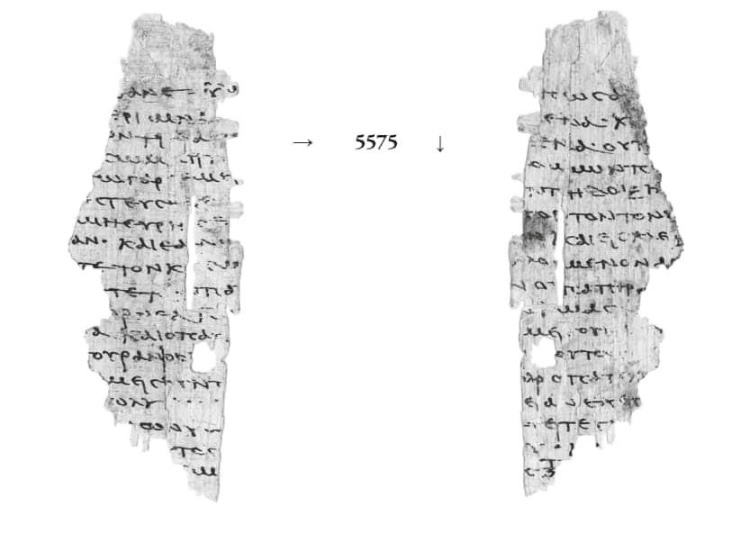
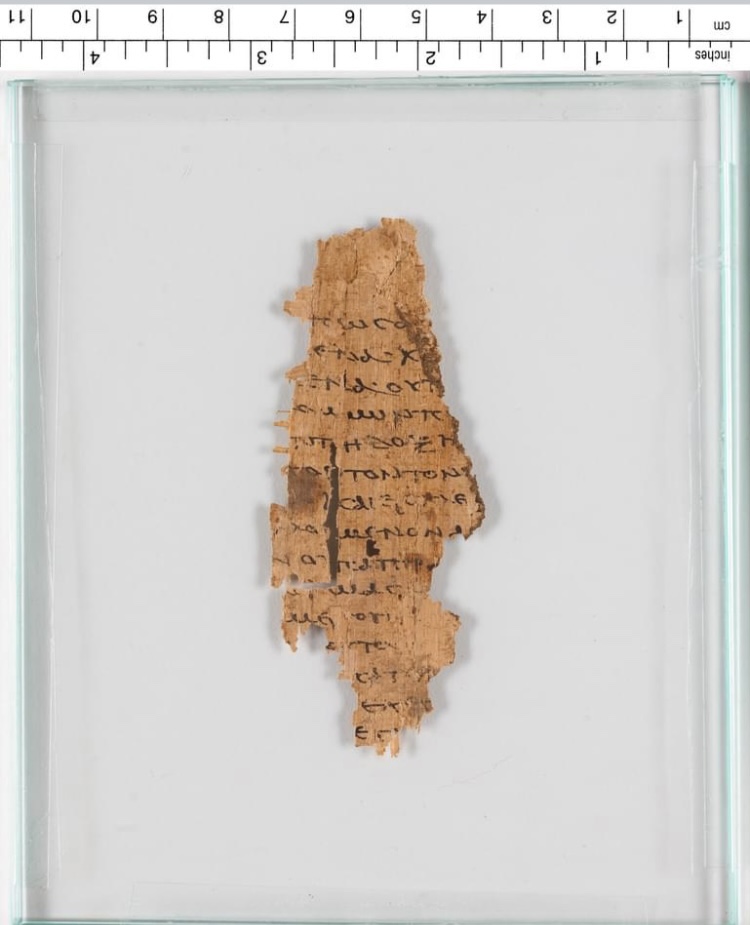
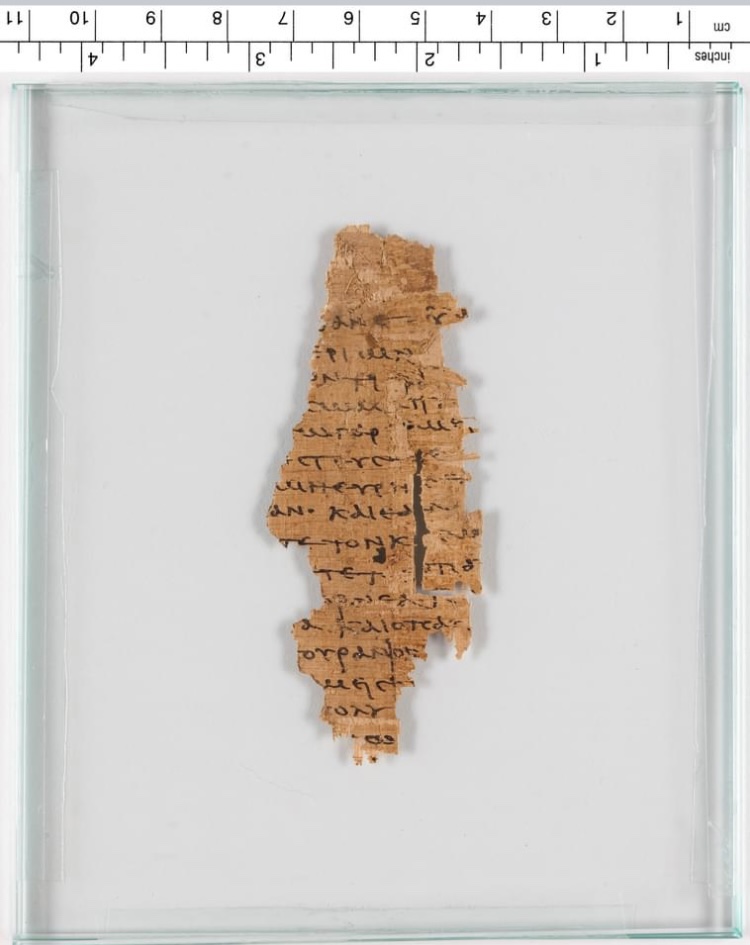
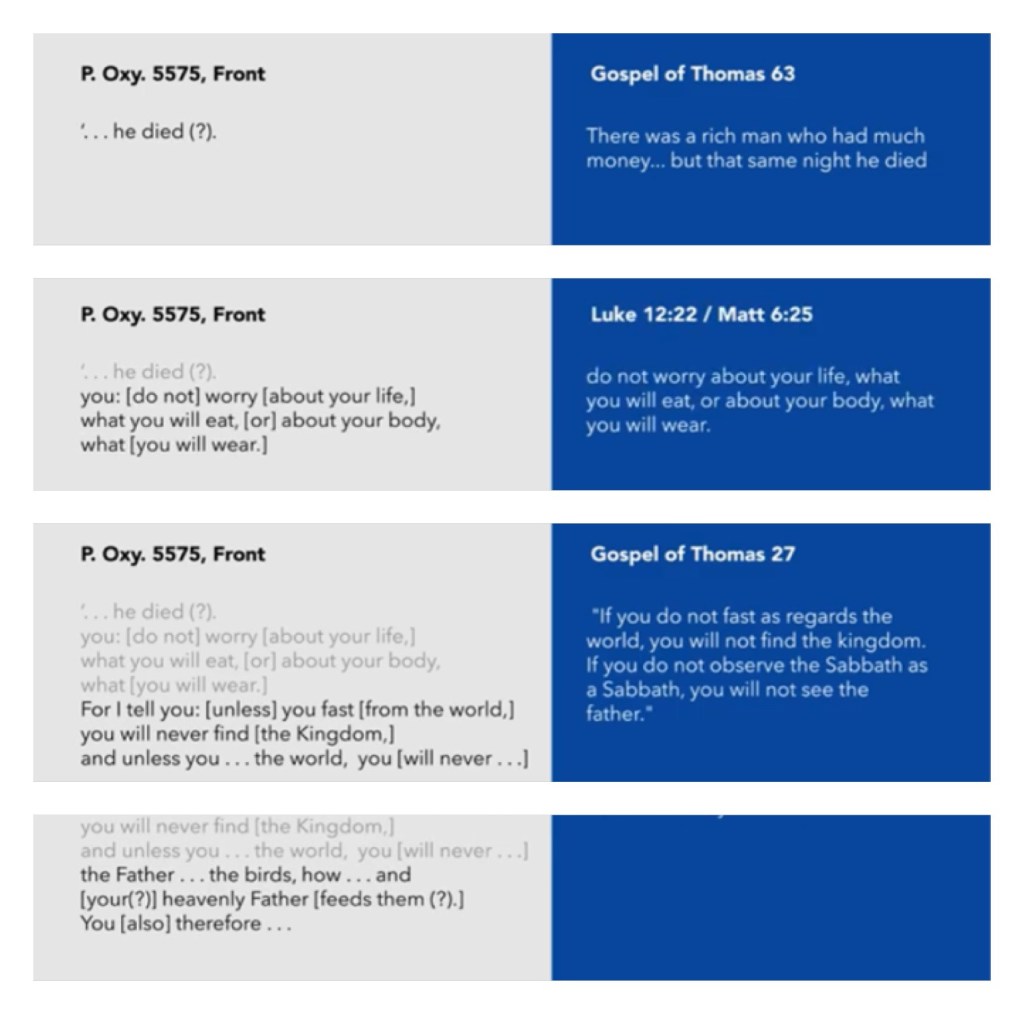
Just published in volume 87 of The Oxyrhynchus Papyri (2023) [1], is a fragment pictured here front and back and is catalogued as P. Oxy. 5575:

P. Oxy. 5575 (2023 photo)

This was a newly rediscovered gospel that was waiting to be identified among the mass of fragments in storage from Oxyrhynchus. This new “Sayings of Jesus” gospel has 19 lines of Greek. It is in the same genre as the gospel of Thomas and the hypothetical Q gospel that many scholars think Matthew and Luke used as a source. Yet according to Candida Moss this gospel is not Q:

When I [Candida Moss] asked Jeffrey Fish and Michael Holmes if they had discovered Q, they were clear that they had not. “Q,” said Holmes “is commonly defined as material deriving from Matthew and Luke.” This fragment also includes sections shared with the Gospels of Thomas and departs from Matthew and Luke in small but important ways. It is, however, a sayings source. Fish tentatively raised the possibility that it may represent material used by the author of the Gospel of Thomas and, thus, present another line of early Christian thought and written tradition.

From her article on the Daily Beast [2]

In the Textual criticism Facebook group Candida Moss further elaborated why it’s not Q, “It’s not just the Thomas parallels. There’s a place where Matthew and Luke agree against 5575.” There are lots of exciting possibilities for this gospel including being a source for Thomas. In the same Facebook group, Stephen C. Carlson said, “The papyrological similarities between 5575 and 4009 (Gospel of Peter) are really striking. The editors are judiciously cautious of course but it wouldn’t surprise me in the end if the fragments came from the same book.”

Dan Wallace who worked on the fragment had the following to say:

All of us independently dated the MS to late second or perhaps early third century, making it the oldest manuscript with text from Matt 6 (Sermon on the Mount). Significantly, the Institute for New Testament Textual Research (INTF) in Münster, Germany, assigns only a handful of New Testament papyri to the second or second/third centuries. Although this is not technically a NT papyrus (it’s syncretistic, including portions from Matt 6, Luke 12, Thomas 27, and perhaps one or two others), that it includes portions from these books at such an early date is astounding. [3]

In the same volume many other extremely interesting papyri are discussed as well:

5575 is an early copy of sayings of Jesus corresponding in part to the canonical gospels of Matthew and Luke and in part to the apocryphal gospel of Thomas. Jesus is also the speaker in 5576 and apparently in 5577, where Mary is addressed. Both pieces may be loosely called ‘Gnostic’; the latter appears to be Valentinian.

Description of The Oxyrhynchus Papyri 87 [4]

Peter Gurry in his blog stated

[I] worked on [this] as a student in the Green Scholars Initiative back around 2012. It was a treat to work on it and I’m very glad to see it finally published. I did get to spend an afternoon with the fragment. [5]

The colour photos were taken from 2013, a slight bit at the end is missing when compared to the 2023 pictures, possibly due to a fold.

In the following article Martijn Linssen makes a quick translation of this exciting new sayings gospel, “P. Oxy. 5575 – an entirely fresh gospel (recto, Part I of II)” [6]

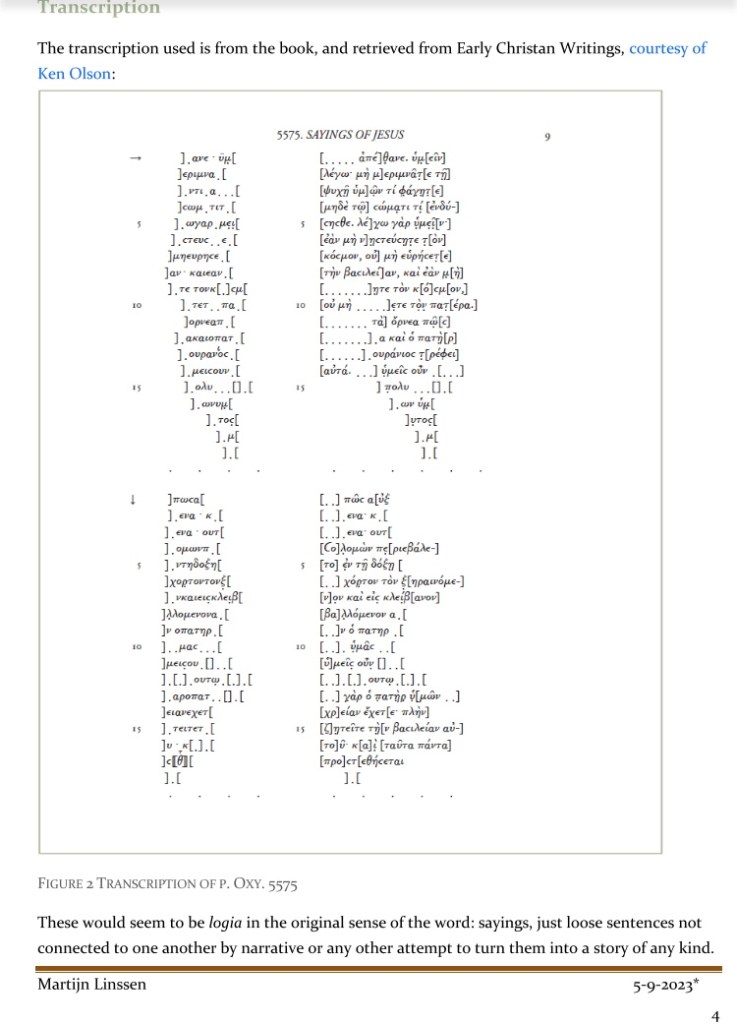
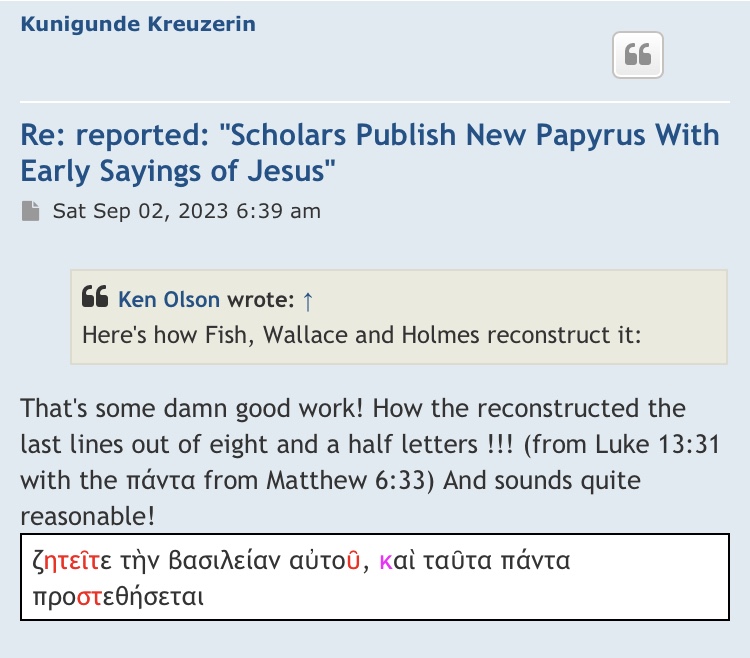
The following transcription is reported by Ken Olson as done by Fish, Wallace and Holmes as on Peter Kirby’s Early Christian Writings site:

From Martijn Linssen’s paper.

Reconstruction of P.Oxy 5575 in English

And Ken Olson reports how Fish, Wallace and Holmes translate it:

‘. . . he died (?). you: [do not] worry [about your life,] what you will eat, [or] about your
body, what [you will wear.] For I tell you: [unless] you fast [from the world,] you will never $nd [the
Kingdom,] and unless you . . . the world, you [will never . . .] the Father . . . the birds, how . . . and [your
(?)] heavenly Father [feeds them (?).] You [also] therefore . . . [Consider the lilies,] how they grow . . .
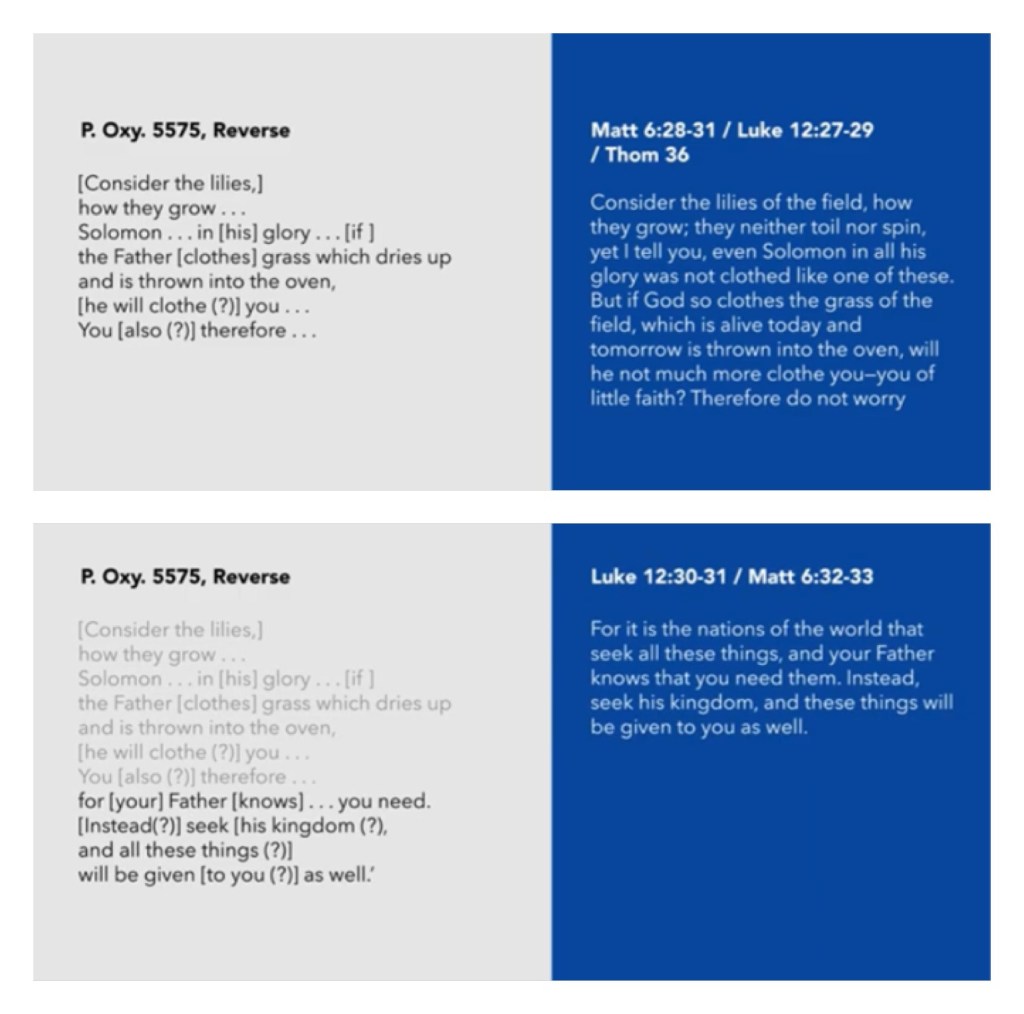
Solomon . . . in [his] glory . . . [if ] the Father [clothes] grass which dries up and is thrown into the oven,
[he will clothe (?)] you . . . You [also (?)] therefore . . . for [your] Father [knows] . . . you need. [Instead
(?)] seek [his kingdom (?), and all these things (?)] will be given [to you (?)] as well.’ [7]

From the Bible unboxed podcast we have the following translation and comparison[8]

Front, the last lines compare to Matt. 6:26/ Luke 12:24
The reverse.

This comment on the skill of translating the fragment-

Mark Goodacre has a cool chart made out here.

Michael Holmes blog on it.

Nogbri observations and comparisons of other fragments are fascinating here.

Ian Mills puts the fragment in context here.

Another link here.

Here are the comparisons done by my friend Andrew Jordan [9]

Luke 12:22
Thomas 27
Matthew 6:26-33

Luke 12:22
He said to his disciples, “Therefore I tell you, do not worry about your life, what you will eat, or about your body, what you will wear.

Thomas 27 (Greek)
Jesus said, “If you do not fast as regards the world, you will not find the kingdom of God. If you do not observe the Sabbath as a Sabbath, you will not see the father.”

Coptic
, “If you (plur.) do not abstain from the world, you will not find the kingdom. If you do not make the sabbath a sabbath you will not behold the father.”

Matthew 6:26-33
Look at the birds of the air: they neither sow nor reap nor gather into barns, and yet your heavenly Father feeds them. Are you not of more value than they? 27 And which of you by worrying can add a single hour to your span of life?[l] 28 And why do you worry about clothing? Consider the lilies of the field, how they grow; they neither toil nor spin, 29 yet I tell you, even Solomon in all his glory was not clothed like one of these. 30 But if God so clothes the grass of the field, which is alive today and tomorrow is thrown into the oven, will he not much more clothe you—you of little faith? 31 Therefore do not worry, saying, ‘What will we eat?’ or ‘What will we drink?’ or ‘What will we wear?’ 32 For it is the gentiles who seek all these things, and indeed your heavenly Father knows that you need all these things. 33 But seek first the kingdom of God[m] and his[n] righteousness, and all these things will be given to you as well.

—————————————————————

[1] J. Fish, D.B. Wallace, and M. W. Holmes (eds), Volume LXXXVII of The Oxyrhynchus Papyri (2023) pp. 6-14.

https://www.bloomsbury.com/uk/oxyrhynchus-papyri-vol-lxxxvii-9780856982521/

[2] https://www.thedailybeast.com/scholars-publish-new-papyrus-with-early-sayings-of-jesus

[3] https://danielbwallace.com/2023/09/04/sayings-of-jesus-papyrus-p-oxy-5575-now-published/

[4] https://www.ees.ac.uk/graeco-roman-memoirs?fbclid=iwar1aiczbf00jns458y_3g1rpby-lib8z4i9qjn4wure6mgkthirpqvqc4ds_aem_atnvgiabwq9iqujy8uxm5g4vhgyltqp5f_lwv2jdpl9sbw4uny-asdb3sitrlsop0lq&mibextid=zxz2cz

[5] http://evangelicaltextualcriticismy.blogspot.com/2023/08/new-2nd-century-sayings-of-jesus.html

[6] httpss://academia.edu/resource/work/106297440

[7] https://earlywritings.com/forum/viewtopic.php?t=11104

[8] https://www.youtube.com/watch?v=DnUiSXNCxRs

[9] https://drajordan.com/

Jesus, Crucifixion and Messianism.

The earliest reference to Jesus’ death and why it happened was in a side note by Paul.

For you, brothers and sisters, became imitators of God’s assemblies in Judea, which are in Christ Jesus: You suffered from your own people the same things those assemblies suffered from the Jews who killed the Lord Jesus and the prophets and also drove us out. They displease God and are hostile to everyone in their effort to keep us from speaking to the Gentiles so that they may be saved. In this way they always heap up their sins to the limit. The wrath of God has come upon them at last.

1 Thess. 2.14-16


This passage was previously thought of as an interpolation but when you go into the actual arguments most were made for theological reasons. The proponents of interpolation had thought the passage was anti Judaic, but ‘the Jews who killed’ Christ were specific Jews, namely the collaborating High Priest who smoothed Roman rule along with the Prefect of Judea. Killing the prophets refers to prophet martyrdom also mentioned in Romans 11.3. These are all internal historic Judaic in-fighting that Paul uses to describe the now internal problems facing the Jesus assemblies. In the words of Simon J. Joseph:

The authenticity of this passage has been disputed, yet the allegedly anti-Judaic tone and content of 1 Thess 2:14–15 is fairly consonant with Pauline theology. In Romans, Paul writes that the Jews have been “broken off ” or “cut off ” from the tree of Abraham (“because of their unbelief”; Rom 11:20) and will not be grafted back until the future, when God’s “wrath” against them comes to an end (cf. Rom 11:11–29). Paul repeatedly appeals to the theme of God’s “wrath” in Romans (2:5, 8; 3:5; 4:15; 5:9; 9:22; 12:19). It seems safe to conclude that not only were some Jews involved in the death of Jesus, but we can be even more specific by identifying the high priest (and chief priests) as disliking him enough to form conspiratorial attempts to stop him, a dislike that ultimately led to a judicial action by the “Sanhedrin” and to Jesus being “handed over” to Pilate, who sentenced him to death. [1]


More recently other arguments were added for interpolation by Carrier when he applied the phrase “But wrath has come upon them at last!” to the Temple destruction. Yet this was a common retrospective fallacy, many historians can fall for such a fallacy as history is done backwards, yet life is lived forwards. The ‘wrath of God’ was a common expression of the Tanakh and could be applied to many catastrophes happening in Paul’s day. In the words of Robert Jewett:

Furthermore, Paul’s statement in I Thess. ii. 16, ‘but God’s wrath has come upon them at last’, may refer to the disturbance which occurred in Jerusalem during the Passover of 49 when twenty to thirty thousand Jews were supposed to have been killed. Cf. Josephus, Ant. 20.112 and War 2.224-7. Since this disturbance was instigated by Zealots (War 2.225), Paul could well have interpreted the massacre as punishment for the persecution against the Christians in Judea.[2]

And of course we could also add other possible disasters that Paul could have had in mind such as Judea suffering famine in 45-47 CE (Ant. 20:49-53). Another reason this passage is unlikely an interpolation is that it is in all the manuscripts and is included in Marcions (the first) New Testament. When we triangulate Paul’s epistles, the gospels and Josephus works, the picture becomes very clear the Jesus was executed by crucifixion (epistles) for being ‘King of the Jews’ (the Titulus crucis in the gospels and Jesus being referred as messiah in the epistles, that is a title signifying an anointed figure such as a king). Bart Ehrman shows that what the Christian sources claim, Jesus crucified under Pilate “accords perfectly well with what we know about the Roman administration of justice in first-century Palestine[3].”

Anyone who attracted crowds, especially the charismatics, messiah figures and of course the Sign Prophets were politically dangerous because they were a threat to Roman security. Ellis Rivkin said that Caiaphas would immediately silenced Jesus as he was “so ominous a threat to law and order” and Pilate would have “made short shrift of a case like this.” Jesus put himself in the firing line of  “Rome’s determination to eradicate anyone who challenged its rule.”.[4] Loveday Alexander observes “ It must be borne in mind that Josephus saw in Messianism as the cause of the 1st Jewish War and that he had personally tried to put a stop to this dangerous current in his eyes by calling Vespasian Messiah.”[5]

Messianism was a dirty word in the aftermath of the Great Jewish Revolt 66-70CE. Much suffering came “in the footsteps of the messiah” and is reflected in this Mishnah passage here: “In the footsteps of the messiah insolence (hutzpah) will increase and the cost of living will go up greatly” (Mishnah soter 9.5).

Yet messianism can be detected in Josephus as Novonsen cutely observes:

John Barclay comments on the Antiquities and Against Apion, “These works show us a Diaspora Jew making a supreme—and in fact the last extant—effort to interpret Judaism for non-Jews in the Graeco- Roman world.” This is the most compelling explanation for why Josephus calls the Jewish insurgents “diadem-wearers” and not “messiahs.” It is not, as de Jonge and Rajak suggest, that they were not messiahs. In all likelihood, at least some of them were, as Josephus implies in the passage about the “ambiguous oracle” that drove them to war. [War 6.5.4- the same passage that applied this same oracle to Vespasian]. Nor is it the case that, as Momigliano suggests, Josephus was blithely unaware of Jewish messianism; here again, Josephus gives us reason to think that he does know something about it. [Examples given in footnote 131 by Novenson:  War 6.312–13; Ant. 10.210; Ant. 17.43–45] Nor, finally, contra Feldman, does Josephus avoid the word “messiah” because he fears that using it would make him sound anti-Roman. On the contrary, Josephus presents himself as a reporter, not a partisan to the revolt, and he makes the insurgents’ anti-Romanness more clear, not less so, by rendering it in a Roman idiom. The explanation, rather, is that Josephus is constrained by literary convention, by his own chosen project of cultural translation from a Jewish idiom to a Roman one. He calls the insurgents “diadem-wearers” for the same reason that he calls the Pharisees “Stoics”: because that is the term by which his audience will understand what he means.[6]

We will finish off this blog with an extract from John Domic Crossan book Render Unto Caesar. Crossan shows how Josephus tries to sweep Jewish messianism under the mat.


“Finally, twenty years after his Romanizing of Jewish eschatology in his Jewish War, Josephus had to face the book of Daniel in his Jewish Antiquities. Although written in the 160s BCE, the book was fictionalized as if written in the 500s BCE and so all its “prophecies” were infallibly accurate (Ant. 10.188–281). But what about the parallel Jewish eschatological promises of the rule of God on earth in Daniel 2:44 and 7:14, 22, 27?

In Daniel 2 and 7, the imperial rules of the Babylonians, Medes, Persians, and Greeks were to be destroyed and, along with Alexander’s successor sub-empire of the Syrian-Greeks, to be replaced by the rule of God on earth. But how could Josephus record such Jewish eschatology, especially since “in the very same manner Daniel also wrote concerning the Roman government, and that our country should be made desolate by them” (Ant. 10.27b)

Watch how he handles Daniel’s Jewish eschatology in those two particular chapters, first with Daniel 2 and its dream vision of a Great Statue and the Great Stone […] having avoided mention of Judaism’s eschatological rule of God in Daniel 2:44, Josephus avoids it again by totally omitting all of Daniel 7. That omission is also quite obviously deliberate. Although Josephus copied the stories in Daniel 1–6 in their proper sequence (Ant. 10.188–218, 232–63), he then skipped Daniel 7 completely and picked up again with Daniel 8 (Ant. 10.269–76).

As Josephus describes the Jewish response to Romanization, his first negation is of any God-founded eschatological motivation for it or any God-decreed messianic expectation about it. For Josephus, Jewish eschatology was mistake at best, delusion at worst, because the climax of time, the end of history, the last or eschatological “rule of God” on earth was the rule of Rome itself. Any validity to a Jewish eschatological vision or a Jewish messianic hope was buried by Josephus in the charred wreckage of Jerusalem.[7]


This shows that Josephus (like most Jews badly affected by it) hated messianism. To him some of the less well known messianic figures that failed to get a mention in Josephus first book War, made it into his later book Antiquities. Even the minor figures that did make it into War, barely register a mention and are quickly moved over. Josephus preferred to talk about himself and made a good chunk of the book about his exploits as commander of the Galilean forces.


[1] Simon J. Joseph, Jesus and the Temple, pp.22-23.

[2] Robert Jewett, The Agitators and the Galatian Congregation, 1971, New Testament Studies, 17(2), p. 205, fn. 5.

For Carriers arguments see Richard Carrier, ‘Pauline Interpolations’, Hitler Homer Bible Christ, The historical papers of Richard Carrier 1995-2013, (Richmond, California: Philosopher Press 2014), pp. 203-211

Also see Matthew Jensen, The (In)authenticity of 1 Thessalonians 2.13-16: A Review of Argument, Currents in Biblical Research 18(1), (2019), pp. 59 –79.

[3] Bart Ehrman, Peter, Paul and Mary Magdalene”, pp.222-223.

[4], Rivkin, What Crucified Jesus?, p.82

[5] Loveday Alexander, “The Gospel according to Celsus, Celsus’ Representation of Christianity” ch 8 in Celsus and his World, Paget and Gathercole (eds).

[6] Matthew V. Novenson, The Grammar of Messianism: An Ancient Jewish Political Idiom and Its Users, (Oxford, 2017), p.147-8.

[7] John Dominic Crossan, Render Unto Caesar, ch 11

Gospel Sources

Even for the most skeptic Jesus minimalists, I find it is untenable to say there is no history in the gospels. We may not have the ability to parse out the history from the mythological, as most of the criteria we use have major faults. Even acknowledging this, there is evidence that even through the medium of a Greek education required to produce the gospels some evidence exists that the source of the material used by the gospels does in fact originate in the Aramaic world and could very well go back to Jesus.

Different traditions coming from different cultures:

As we can see here in the gospels some traditions came from the Jewish culture, some were from the Greaco-Roman. Here are five test cases-

1. ARAMAIC:

I think the jar maker was a picked up Aramaic tradition, one instance where I think an original Aramaic story was picked up is the following:

The episode of Jesus’ anointing at the lepra’s house, the question is, why is anybody there?

Biblical scholars have recognised Simon could not have had lepra at the time Jesus visited his home. So we have to look at some further explanation.

As seen from the following paper, Enter the house of Simon the Lepra, naird to anoint Jesus. Aramaic translated the word in place of lepra as “jar merchant”.

(The reason for this mistaken mistranslation is the ancient Aramaic has no vowel markings… The word for “Lepra” is gimel-resh-beyt-aleph or GRBA Pronounced as “gar-bah” which is the same spelling of the word for the word “Jar Maker” spelled GRBA but pronounced “gar-ah-bah”. So to recap Lepra = “ga-bah” and Jar Maker = “gar-ah-bah”!)

This gets rid of the oddity of going to the lepra’s house. This verse would make more sense as a Jar merchant. This could have been a story circulating about Jesus’ anointing, as he was declared a messiah by his followers?

http://www.tabernacleofdavidministries.com/wp-content/uploads/2012/10/Aramaic-NT.pdf

————————————————

2. GREEK:

They say that the Eucharist comes from Seder yet no Jew ever would say “drink my blood”. The drinking blood looks like the rituals of Dionysus, blood of the grape, bread of the grain. This ritual fits better as being Judaized to a new Passover. (Robert M. Price)

As Piñero states, in The True Passion of Christ, P.132:

“Paul seeks his future conversations among those Gentiles most willing to accept Jewish ideas, that is, among pagan sympathisers with Judaism. And when among these, which the Acts of the Apostles call the “God fearers” (Acts 10, 2-22-35), they do not offer enough, he turns his eyes to other very religious pagans who sought in the beginnings of the “religions of mysteries” the possibilities of ensuring salvation and immortality. It is known that one of the rites that existed in these religions was to make visible communion with the destiny of divinity—a divinity that somehow suffers death or passion, but then returns to life also in some way—through the ingestion of something that symbolized that deity. Among the followers of the mysteries of Dionysus the ingestion was the flesh of a kid that symbolised the god, and among the mysteries of Atis a mixture of bread and liquid was ingested.”

————————————————-

3. ARAMAIC

Semitisms are linguistic features within the Greek texts which are dissimilar and otherwise unused in the Greek language but common and well known in the Semitic languages and translations of Semitic texts such as the LXX.

Hebrew and Aramaic use particles or prepositions to indicate the case of a noun and its function in the phrase or sentence (unlike Greek which has an inflectional noun declension). So overuse of nouns and pronouns connected to possession, nominative and accusative case is extremely bizarre writing in Greek but normal in NW Semitic. Hebrew and Aramaic use particles or prepositions to indicate the case of a noun and its function in the phrase or sentence. (unlike Greek which has an inflectional noun declension), so overuse of nouns and pronouns connected to possession, nominative, and accusative case is extremely bizarre writing in Greek but normal in NW Semitic.

Redundancy of Nominal/Accusative/Genitive phrases
-συμπόσια συμπόσια: 2 times in Mark 6:39-42

Idiomatic Narrative Phrases

  • ἀποκριθεὶς εἶπεν in Mark 6:37
  • Ἐν ἐκείναις ταῖς ἡμέραις in Mark 8:1
  • ἔκλασεν καὶ ἐδίδου in Mark 8:6
  • This would mean that there was a previous text or saying which would have been translated from a Semitic language into Greek.

To make a comparison, let’s take the Irish in America – we refer to them as “plastic paddies”, they try to be Irish but they are different. They have a few words (cupla focail) of Irish but they can’t speak it (gospel markings are similar, a few words of Aramaic and that’s it. They know the Irish background and know that the British starved us to death in a major famine of 1845-50, just as the Jewish diaspora of a couple of generations ago knew about the destruction of the Temple. Lots of modern analogies. They are the comparisons in which the gospels were produced through the Roman book culture.

4. GREEK:

(From Bart Ehrman)

John, 3:1-21, Jesus says to Nicodemus “You must be born again.” The Greek word translated “again” actually has two meanings: it can mean not only “a second time” but also “from above.” Whenever it is used elsewhere in John, it means “from above” (John 19:11, 23). That is what Jesus appears to mean in John 3 when he speaks with Nicodemus: a person must be born from above in order to have eternal life in heaven above. Nicodemus misunderstands, though, and thinks Jesus intends the other meaning of the word, that he has to be born a second time. “How can I crawl back into my mother’s womb?” he asks, out of some frustration. Jesus corrects him: he is not talking about a second physical birth, but a heavenly birth, from above.

The Greek double entendre makes little sense in Aramaic and therefore not historical. This is a double entendre that works only in Greek.

—————————————————

5. ARAMAIC

Some Greek sayings of Jesus make better sense in Aramaic as in the case of the Sabbath saying found in Mark:

“Then he said to them, ‘The Sabbath was made for man, not man for the Sabbath. Therefore the Son of Man is Lord even of the Sabbath.” (Mark 2:27-28)

Here Bart explains this best:

Jesus informs his Jewish opponents, “Sabbath was made for man, not man for the Sabbath. Therefore the Son of man is Lord even of the Sabbath.” When you look at that saying closely and try to figure it out, in fact it doesn’t actually make sense. What is the “Therefore” there for? Why does the fact that Sabbath was created for the benefit of humans, not humans for the benefit of the Sabbath make the Son of man (Jesus) the Lord of the Sabbath? The saying does make sense when put back into Aramaic, however. That’s because “man” and “son of man” are the same term in Aramaic; bar enash. And so what Jesus said was “Sabbath was made for bar enash, not bar enash for the Sabbath. Therefore bar enash is lord even of the Sabbath.” Now the saying makes perfect sense. Humans are lords of the Sabbath, not the other way around. Human need takes priority over the commandment not to work on the Sabbath.

Taken from Bart Ehrman blog: https://ehrmanblog.org/jesus-teaching-in-aramaic-and-the-books-of-the-canon-mailbag-february-24-2017/

This shows that some material used by the gospels were picked up from sayings originally circulating in Aramaic-speaking Palestine.

CONCLUSION:

Bultmann envisages the Jesus tradition as ‘a series of layers’, Hellenistic and Greek, Palestinian and Aramaic, within which again ‘different layers can be distinguished’. (Dunn, Jesus Remembered, page 76).

In conclusion some of the Aramaic traditions picked up shows that oral tradition did have some affect on the composition of the gospels.

Much of the Jewish content were tanakh allusions. The gospels are soaking with Tanakh allusions. Yet we find these allusions were trying to say something of a historical figure. Taking the example of the messiah concept, in the Tanakh context, the messiah had always been a historical figure. Messiah is a human figure, one who will have children and perform a sacrifice for himself. The Messiah will do sacrifices for his own ‘accidental sins’ as seen in Ezekial 45:22: “And upon that day shall the prince prepare for himself and for all the people of the land a bullock for a sin-offering.” (Cf Leviticus 4). The Messiah will have children as seen in Ezekial 46:16: “Thus saith the Lord GOD: If the prince give a gift unto any of his sons, it is his inheritance, it shall belong to his sons; it is their possession by inheritance.”

There were random verses picked to show Jesus fulfilling messianic expectations. Not the best ones such as mentioned above were picked. This suggests that those that did not fit the historic Jesus could not be used. It looks like whatever traditions there were about Jesus, they picked the Hebrew scripture that could go along with it.

We do know there was oral tradition as there were missionaries, and more than just Paul as attested in his letters. Good case for oral tradition is the following:

-Paul mentioned other missionaries.

-Therefore there were active missionaries in the Jesus movement.

-What they preach and had to explain- is the oral tradition.

-These oral traditions influence what scriptures were used to tell Jesus’ story.

-The gospels making use of the letters of Paul would inherit any oral tradition encased in Paul’s letters, one example would be the ‘divorce saying’ Paul’s quotes Jesus as saying.

While the content of the gospels include Jewish material, the framework is definitely Greco Roman as David Aune said. [1] Much exciting scholarship on the Greco-Roman framework is done in this area by the likes of Dr Robert Miller (comparing the gospels to translation fables, the purpose of the writings was to apotheosise the adherent) [2], Litwa (who shows similar linguistics used by other Greek literature such as the virgin concept),[3] Robyn Walsh (who shows the gospels did in fact come out of Roman book culture)[4] MacDonald (who shows memises with other Greek literature)[5]. So within this Greco-Roman framework we have some material of historical interest and some of that material did not even have a Tanakh allusion to match. We find the crucifixion does not have any allusions. This implies more of an apologetic for what really happened rather than a symbolic meaning which is not found, “and could thus not have been prompted by a desire to bring the record of Jesus’ last hours into accord with divine prediction”. [6] While we do have much historical fiction in the retelling of the execution of Jesus, the evangelists were aware of the historical crucifixion of their hero and wrote an apotheosis to match.

————————-

[1] David Aune, Greco-Roman Literature and The New Testament, Westminster Press, 1987.

[2] Richard Miller, Resurrection and Reception in Early Christianity, Routledge, 2015.

[3] see David M Latwa, Ieuses Deus, ch2.

[4] Robyn Faith Walsh, The Origins of Early Christian Literature, Contextualizing the New Testament within Greco-Roman Literary Culture, Cambridge, 2021.

[5] Dennis MacDonald, The Homeric Epics and the Gospel of Mark, Yale, 2010.

[6] A. Fitzmeyer, The Gospel According to Luke I–IX (Garden City, N.Y.: Doubleday, 1981), 773.

C’mon guys, it’s obvious Paul was on about a recently dead person.

It’s no conspiracy among academics why 99% of scholars know Paul was on about a recently deceased executed person. Anyone who knows anything about this time period, 1st century CE, and the worldview (apocalypticism) of the Jewish missionaries that started a movement in the diaspora know from the language and idioms of Paul that he is talking about a historical person recently deceased.

Paul’s letters assumed Jesus existed when read through 1st century Jewish apocalypticism. To second Temple Jews only actual people resurrect, Paul constantly proclaims that Jesus has resurrected, that point alone cannot be got around by any mythicists. This brings Jesus existence up to 99% probability, 1% doubt is only if Paul’s letters are made up which is also unlikely.

Paul’s pretty explicit that Jesus was human and in second Temple terms understands “resurrection of the flesh.” —

“For since death came through a human being, the resurrection of the dead has also come through a human being; for as all die in Adam, so all will be made alive in Christ.” (1 Cor. 15:21-22)

In Jewish reckoning at the time, resurrection can only happen to actual people and Earth is where humans are – they’re literally made out of material from the Earth (as Paul understands as well – see 1 Cor. 15:46-49). This is a problem for mythicism.

Anyway let us go through some other indicators that Jesus was historical:

Paul already referred to Jesus as in the flesh so he clearly has placed Jesus on earth. The phrase “Kata Sarka” (according to the flesh) in 2 Cor. 5:16 cannot refer to an otherwordly existence. In the context of the letter: Paul uses spiritual and fleshy people to mean spiritual and unspiritual. “Those interpreters who followed Baur in regard to the theological centre of Paul were convinced that Paul’s language about the Spirit and its antithesis—the flesh—came from the Greek world of thought.” [1] Unspiritual cannot be applied to Jesus when Paul describes him “according to the flesh” in the context of this verse, so it can only have one meaning: that of when Jesus was alive.

Paul, also sees Jesus was believed to be of Davidic descent according to the flesh (σαρξ).

the gospel concerning his Son, who was descended from the seed of David according to the flesh

περὶ τοῦ υἱοῦ αὐτοῦ, τοῦ γενομένου ἐκ σπέρματος Δαυεὶδ / Δαυὶδ κατὰ σάρκα

Rom. 1:3

I don’t accept 1 Thess. 2.14-15 as an interpolation as that was only argued as an interpolation on theological grounds. Here is a footnote in one of my papers:

Most of the arguments proposed for interpolation were done on theological grounds. Most of Carrier’s analyses are only applicable to the passage when “But wrath has come upon them at last!” is applied to the Temple destruction. See Richard Carrier, ‘Pauline Interpolations’, Hitler Homer Bible Christ, The historical papers of Richard Carrier 1995-2013, (Richmond, California: Philosopher Press 2014), pp. 203-211; Yet that is only a retrospective fallacy as Jewett has shown many local catastrophes, “Furthermore, Paul’s statement in I Thess. ii. 16, ‘but God’s wrath has come upon them at last’, may refer to the disturbance which occurred in Jerusalem during the Passover of 49 when twenty to thirty thousand Jews were supposed to have been killed. Cf. Josephus, Ant. 20.112 and War 2.224-7. Since this disturbance was instigated by Zealots (War 2.225), Paul could well have interpreted the massacre as punishment for the persecution against the Christians in Judea.” Quote from Robert Jewett, The Agitators and the Galatian Congregation, 1971, New Testament Studies, 17(2), p. 205, fn. 5. This is not the only disaster as Judea also suffered famine in 45-47 CE (Ant. 20:49-53). For a full set of the arguments see Matthew Jensen, The (In)authenticity of 1 Thessalonians 2.13-16: A Review of Argument, Currents in Biblical Research 18(1), (2019), pp. 59 –79. [2] So here we have Paul talking about Jesus on earth in the recent past.

So mythicists say that Paul referring to Jesus as a human is acceptable to mythicism (which is fair enough all you have to do is think of Dionysus in the play the Bacchae). But the point I’m making is – that to apocalyptic Jews people resurrecting is inconsistent to mythicism. Jesus being resurrected clearly means Paul is talking about a recently dead person.

To apocalyptic Jews only actual people resurrect, you cannot get around this with any second temple evidence, the only way you can get around this is by making stuff up.

As this post hinges on Paul’s letters being Apocalyptic, let’s show you just how apocalyptic they really are!

We have another set of literature that’s apocalyptic and that is the Dead Sea scrolls.
Let’s do a comparison,
Why the DSS were so valuable is that they give a cross section of a diverse amount of Jewish sects that existed just before the first century CE.
Pauls epistles were based on a now obsolete belief system where Satan is in control of this age right now. The same can be seen in the DSS, but this prince of darkness was known as Belial. Belial is mentioned many times in the Scrolls; Rules of the Community (Manual of Discipline) (3 times) the War Scroll (9), the Thanksgiving Hymns (4), the Psalms and Psalms Pesher (2), and some other miscellaneous texts (7). Paul refers to Satan as Belial in 2 Cor 6:15. Paul’s epistles are primarily concerned with the overthrow of bad angels. Everything that is going bad out in the real world would be Satan or Belials fault.
In both the epistles and DSS there are also good angels who fight the bad spirits. God will send a messiah who is going to join humans on earth on the last days (eschatological mindset where god will bring in the kingdom of god right here on earth in the last days). In both the epistles and some scrolls the messiah is going to be of “the seed of David” ie somebody descended from the line of David. (4Q174 III: 1-9 and Romans1:3; Cf Jeremiah 23:5; b.Talmud Rosh Hashanah 25a; Eusebius,EH 3.19; 3.20.1-6).
Another apocalyptic idea is that humans were buried and would rise on the last days and they can also have eternal life. Some will be raised in eternal life and in Daniel it says others will be condemned and held in contempt. There will be sin and atonement made for sin.
Some passages in Pauls epistles are better understood with what we know about apocalyptic Jews as revealed in the DSS.
Here we will examine some examples

  • Galatians 4:4 “Born of a woman”. Apocalyptic Jews used this phrase “born of a woman” to say that somebody was a human. The scroll 4Q264 addresses God writing “man among your glorious works as why he can be born of a woman”. Another example 1 QS (Community Rule) 11.21 – it says man is “one born of woman… shaped from dust has he been”.
    The phrase always refers to actual people and not celestial people.
  • Romans 9:5 where Jesus is the messiah, “whose are the fathers, and of whom is the Christ, according to the flesh, who is over all, God blessed to the ages.” Jesus being the ‘messiah (Christos) according to the flesh’ would be a term used by apocalyptic Jews to refer to human figures. The title messiah was becoming otherworldly at this time, an expectant end times judgment figure. The difference with the letters is that to Paul Jesus was a ‘realized messiah’ as opposed to an ‘expectant messiah.’ Paul sees Jesus as a realized messiah is the fact he thinks the new age has started. A realised messiah will usher in the new age, establish a new kingdom of god right here on earth. Jesus is the ‘first fruits’ of this new started age (1 Cor. 15:20). All realized messiahs were human figures.
  • Romans1:3 “seed of David”; Romans 15:12 “the root of Jesse” (King David’s father):
    The primary focus of ancient Judaism is the restoration of the Davidic line. 4Q174 III 1-9 is a Midrash on 2 Samuel 7:10-14 (and the use of Exodus15:17-18, Amos9:11) for the restoration of Davids house (dynasty). The branch of David is going to rise as somebody in Zion (Jerusalem) as an interpreter of the law. This branch is going to be the righteous messiah.
    Like other apocalyptic Jews, early Christians thought that Jesus was the messiah that came from the branch of David.
    Jews went to these two verses in the Hebrew Scriptures to say that the messiah would come from the branch of David:

    “bless the house of your servant, that it may be in your presence forever—since you, Lord GOD, have promised, and by your blessing the house of your servant shall be blessed forever.” (2 Samuel 7:29)

    “For this is what the LORD says: ‘David will never fail to have a man to sit on the throne of Israel..” (Jeremiah 33:17) All messianic movements claimed their line from King David. (We know this from the Dead Sea Scrolls, 4Q174 III: 1-9; Pauls epistles, Romans1:3; Cf Jeremiah 23:5; b.Talmud Rosh Hashanah 25a) All messianic movements claimed their line from King David. (We know this from the Dead Sea Scrolls, 4Q174 III: 1-9; Pauls epistles, Romans1:3; Cf Jeremiah 23:5; b.Talmud Rosh Hashanah 25a)
  • 2 Cor. 6:15 in this verse Paul refers to Satan as Beliar, “What harmony is there between Christ and Belial? Or what does a believer have in common with an unbeliever?” Paul also refers to “Satan” or “Belial/Beliar” as one who tempts and deceives (1 Cor 7:5; 2 Cor 2:11). [3] In
    1 Thess 3:5 Satan is called “the tempter.” Paul sees Belial as in charge of the current dark age, whereas the new light age initiated by Christ has started, and this new age of lightness is headed by Christ, this is where Paul’s believers belong. Belial is also seen as in charge of the current age in the Dead Sea Scrolls. The opening of the War Scroll has “The first attack of the Sons of Light shall be undertaken against the forces of the Sons of Darkness, the army of Belial” (1QM I1).
  • Philippians 2:8 that Jesus died on a Stauros.
    Josephus uses this term Stauros to tell of Romans crucifying Jews.
  • 1 Cor. 15:4 “buried.”
    To be buried after crucifixion was a first century practice.
    Resurrected Jesus was the “first fruits of those who have died” (1 Cor 15:20-23):
    Following this Paul says Jesus was raised and that the other apostles had seen him. Paul and the other apostles all previously believed that Jesus had been alive, for according to apocalyptic Jews (especially seen in the book of Daniel), you had to be a living person before you could be resurrected. They all interpreted these sightings of Jesus in light of the apocalyptic idea of Resurrection. This mindset involved the idea of the dead being buried in the ground, in the earth and being raised again, literally in history on the last day of earth.
    “2 And many of them that sleep in the dust of the earth shall awake, some to everlasting life, and some to shame and everlasting contempt” (KJV Daniel 12:2)
  • Romans 16:25-26 (NIV)
    “25 Now to him who is able to establish you in accordance with my gospel, the message I proclaim about Jesus Christ, in keeping with the revelation of the mystery hidden for long ages past, 26 but now revealed and made known through the prophetic writings by the command of the eternal God, so that all the Gentiles might come to the obedience that comes from faith“
    In the scroll Commentary on Habukkah “God revealed the mysteries of the scriptures, the servants prophets to the Teacher of Righteousness”. (These arguments using the DSS were made by Dr. Winchester in his debate with Carrier [4])

In line with apocalypticism Paul has a “firm belief that he lived and worked in history’s final hour is absolutely foundational, shaping everything else that Paul says and does… asserting the nearness of the End: “You know what hour it is, how it is full time now for you to awake from sleep. Our salvation is nearer now than when we first believed. The night is far gone; the day is at hand” (Rom 13.11–12).” [5].

Paul refers to several events which are hard to explain on mythicism: brother in Gal 1:9; he is a descendant of David in Rom 1:3 and Jesse in Romans 15:12-13, he is born under the law Gal 4:4; belonging to the race of Abraham (Gal 3:16; Rom 9:5) exercising a ministry to Israel in fulfillment of the promises to the patriarchs (Rom 15:8), being crucified on a cross (passim Paul’s letters) and then 1 Thess 2:14-16 which says that Christians were being persecuted by the same men who killed Christ, and the only mythicist explanation for this is to propose a conjectural emendation with no real evidence.

Paul keeps referencing people who knew Jesus. These same people started checking up on Paul. Paul is under a great deal of stress for not meeting the figure of Jesus. He is challenged about his credentials. He knows the people who have met Jesus, Peter, James, his brothers. If Jesus was mythological, none of that anxiety would have existed. None of the bravado that he was better than those who knew Jesus. He would not have had to prove himself a better Apostle than those that knew Jesus. His great big battle is with those that knew Jesus in the flesh, and he stresses, “hey I’m not inferior to all of you”. Paul was fighting for credibility, by claiming his Jesus was different from the Jesus that was alive and crucified. (These arguments were made by Goodacre in a debate with Carrier [6]). As Paul describes a group of contemporary Jesus believers as if they were historical – on earth and contemporary – and later on they appear to deeply annoy him. They cannot therefore be symbolic inventions. On this basis Paul is reporting on people who knew Jesus.

“Am I not free? Am I not an apostle? Have I not seen Jesus our Lord? Are you not the result of my work in the Lord? 2 Even though I may not be an apostle to others, surely I am to you! For you are the seal of my apostleship in the Lord.” (1 Cor. 9:1-2)

He was jealous of those who had met and seen Jesus. Therefore he was trying to be better than James and co, explaining that Jesus personally appeared to him. That that was a different Jesus from when he was alive. (2 Cor.11:4).

These same men are claiming that Paul’s authority is suspect. In response, Paul has pointed out how he obtained his understanding of the gospel directly from Christ, (Paul was having visions of the recently dead Jesus) and that he was in total agreement with the other apostles. According to Paul the three most influential leaders, James, Cephas (this name means “rocky” in modern English, the Greek for “Rocky” would be Petros from which we get Peter) and John, saw the grace given to Paul by God to carry out his ministry (Gal. 1:15).

Paul speaks of the community once as having known Jesus “according to the flesh”, but that it is now something they need to move on from. So if Peter, James and John are “pillars” of the movement, it stands to reason that they knew Jesus “according to the flesh”:

“From now on, therefore, we regard no one according to the flesh, even though we regarded Christ according to the flesh, we know him no longer in that way.” (2 Cor. 5:16)

We also get plenty of hints about the historical Jesus from Justin and others. For instance, Justin specifically refers to Jesus being executed by Pilate. These hints are continued in the earlier form of the Testimonium Flavianum and Tacitus Annuls.

Marcion also thought Jesus appeared in history as well, he had an entire gospel. It should be noted that Marcion also retained 1 Thess 2:14-16 as well. (A sign against interpolation).

So overall, there is just no reason to accept the idea that Paul thought Jesus was an exclusively revelatory figure.

[1] Ann Jervis, “Paul the Theologian” in Pauline Studies, eds Novonsen and Matlock, Oxford 2022, p. 81

[2] David Allen, A Model Reconstruction of What Josephus would have Realistically Written About Jesus. JGRChJ 18 (2022), Page 138, Footnote 76.

[3] Jörg Frey, Qumran, Early Judaism, and New Testament Interpretation, p.322

[4] Dr Winchester use of the DSS in defence of the historicity of Jesus was outstanding.

https://www.facebook.com/groups/1038530526485151/permalink/1058276467843890/

[5] Paula Fredriksen, Paul, The Pagan’s Apostle, (Yale, 2017), Preface.

[6] see Goodacre debate Carrier here:

https://www.youtube.com/watch?v=0EulhS8EkJk

Survival of the Jesus movement

Most messianic groups collapsed in the aftermath of the execution of their leader, the spell the sign prophet put his incredulous followers under would be broken when neither sign nor Gods intervention was realized. Belief in resurrection is not enough to explain the survival of this movement, eschatological belief in resurrection was common in second temple Judaism, (cf. Dan 12, 4Q521) to outsiders of the group, it would be scoffed at. There were two crucial factors in conjunction with belief of the resurrection that helped the survival of the Jesus movement. The first was Jesus’ brother James was there to carry on the movement and the second was they decided to head the movement from Jerusalem. While most messianic groups collapsed after the execution of their leader, the survival of the Jesus movement was that there was a brother who survived and was there to carry the movement forward. This helped the survival of the Jesus movement in the aftermath of his execution. James was in charge of the movement as evidenced from Paul (Gal. 2.12). That and the fact they stationed in a very central city for Judaism, Jerusalem. This helped when diaspora Jews became interested in a few eschatological missionary letters sent by Paul. Using a common second temple concept of resurrection of the dead gave hope that Jesus would come back (in fact it was understood that Jesus would come back as an eschatological saviour figure). We have an abundance of Second Temple Jewish texts that reflect these hopes:


As for Second Temple Jewish texts in which a divinely appointed human being rules as the eschatological king, they are just as numerous. Indeed, we have here an embarrassment of riches, for every passage that awaits a Davidic Messiah is expecting the eschatological advent of a royal human figure. 4Q174 1:11–13 cites 2 Sam 7:11–14, which is about King David’s heir, and applies it to the “Shoot of David,” who will arrive “at the end of days.” CD-A 7:15–21 interprets Num 24:17 (“A star shall come out of Jacob, and a scepter shall rise out of Israel”) with reference to “the prince of the congregation,” an eschatological figure for the Qumran sectarians. 4Q252 5:1–4, in interpreting Gen 49:10 (“The scepter shall not depart from Judah, nor the ruler’s staff from between his feet, until tribute comes to him; and the obedience of the peoples is his”), looks forward to the “Messiah of righteousness, the Shoot of David,” who has “the covenant of kingship.” Psalms of Solomon 17:32 foretells the coming of “the Lord Messiah,” who will be “a righteous king.” And so it goes. Jesus’ Jewish world was quite familiar with the idea of a human being serving as eschatological king and/or judge.[1]

As people questioned me in the Facebook groups- “Why do you think “Jesus” was singled out and given a resurrection story and a new definition of messianism as opposed to the other sign prophets?” (Carl Reyer).

My answer- “I think the others were given all that too, but it was due to the likes of Marcion (massive shipping magnate) or Valentinus (hugely popular teacher in Alexander) picking up Paul’s letters that put Jesus into the big time. Other movements that tried to survive using second temple theology is evidenced in the messiah stone (possibly connected to Simon of Perea) and the DSS etc… This one being remembered is purely a historical chance that Paul’s letters were picked up by a rich ship merchant (Marcion) which enabled this movement to spread.”

Just like Ezekiel, a failed prophecy was applied to Jesus- but it was too strongly attributed to leave out. In the book of Ezekiel there was an attempt to upgrade his failed prophecy that Tyre would fall by Nebuchadnezzar, by re-explaining it that he would get his booty from Egypt instead. In the Synoptics they tried to explain it away as a false prophecy put on the lips of his enemies.

Of course a prophecy seemingly coming true put on the lips of Jesus in the gospel of John, whether applied ex eventu or not, put his fame ahead of any of the other sign prophets. Of any oral tradition that existed it is a prophecy circulating that is remembered most.

We know most messianic movements eventually died out in the aftermath of their leader executed- something different happened with Christianity, the gentiles didn’t really care about the Jewish messiah concept, therefore Christianity thrived among Paul’s converts. Christianity eventually died out among the likes of the ebionotes (who found it harder to convert their fellow Jews) etc.


[1] Allison, Constructing Jesus, p.252-3